


AI-powered SEO tools promise to automate everything from product descriptions to schema markup. Most WooCommerce merchants waste time testing plugins that either conflict with each other, generate generic content, or require constant manual oversight.
The key question isn’t whether to use AI for SEO – it’s which AI capabilities actually move the needle for ecommerce, and how to integrate them without breaking your existing setup.
What AI actually does for WooCommerce SEO
AI tools for WooCommerce fall into four categories: content generation, technical optimization, analytics automation, and ongoing maintenance.
Content generation covers product descriptions, meta tags, alt text, and blog content. AIOSEO automates repetitive SEO tasks including auto-generating XML sitemaps and schema markup. Rank Math offers 750 AI credits per month in its free plan for AI-powered tools that enhance content’s search performance.
The problem: most AI content generators don’t understand your product catalog. They’ll write about “blue cotton t-shirts” without knowing you’re currently out of stock in size medium, or that your bestseller is actually the navy variant.
Technical optimization handles structured data, canonical tags, image compression, and sitemap management. Rank Math is ranked as the top choice for WooCommerce SEO with a 4.7/5 overall score, offering the best balance of features including local SEO schema and image SEO capabilities that competitors reserve for paid plans.
Analytics automation transforms raw Search Console data into actionable insights. The ecommerce SEO dashboard from ContentGecko breaks impressions, clicks, and CTR down by page type – category pages, product pages, and blog content analyzed separately. You can see if your category pages need better optimization or if product pages are getting indexed properly.
Ongoing maintenance is where most stores fail. Products change. SKUs get discontinued. Prices update. URLs shift. AI should handle these updates automatically, not require you to manually republish 200 product descriptions every time you run a sale.
Comparing leading AI-powered WooCommerce SEO tools
General WordPress SEO plugins with AI features
Yoast SEO works with WooCommerce to increase online store visibility through standout product titles and descriptions with tailored SEO analysis on product pages. It’s solid for breadcrumbs and basic schema, but the WooCommerce add-on is a separate paid extension and the AI features are limited to readability suggestions.
Rank Math includes built-in WooCommerce SEO functionality and connects with Google Analytics for traffic insights. Its free version includes local SEO schema, image SEO capabilities, and WooCommerce SEO features that many competitors charge for. The AI integration is newer and focused on content suggestions rather than catalog-aware automation.
The SEO Framework automatically generates improvements to product listings including critical SEO metadata, eliminating some need for advanced SEO expertise. It features a unique single-page sitemap that helps search engines rapidly find new product listings and is significantly faster than competing SEO plugins when tested alongside them. But it lacks AI-powered content generation entirely.
SEOPress is positioned as the best value option – a lightweight, fast plugin that doesn’t clutter dashboards with ads. Like The SEO Framework, it focuses on technical SEO fundamentals without AI features.
Standalone AI SEO platforms
Clearscope is a user-friendly AI-powered SEO tool that analyzes SERP patterns to generate keyword-based term suggestions and grades content comprehensiveness. It’s excellent for blog content but doesn’t integrate with WooCommerce product data and requires manual content import/export.
Surfer SEO offers Rank Tracker for daily keyword monitoring and Keyword Research for content clusters, along with AI-powered features including Surfer AI and AI Tracker. It has 419+ reviews on Capterra with an average rating of 4.9/5. Like Clearscope, it’s built for content teams writing blog posts, not store owners managing thousands of SKUs.
Semrush Copilot provides AI-powered recommendations about technical issues, keyword opportunities, competitor ranking changes, and organic visibility fluctuations. It’s powerful for competitive intelligence but operates outside your WordPress installation.
Catalog-aware WooCommerce solutions
Most existing tools fall short here. You need AI that understands your product catalog, monitors inventory changes, and updates content automatically when SKUs change.
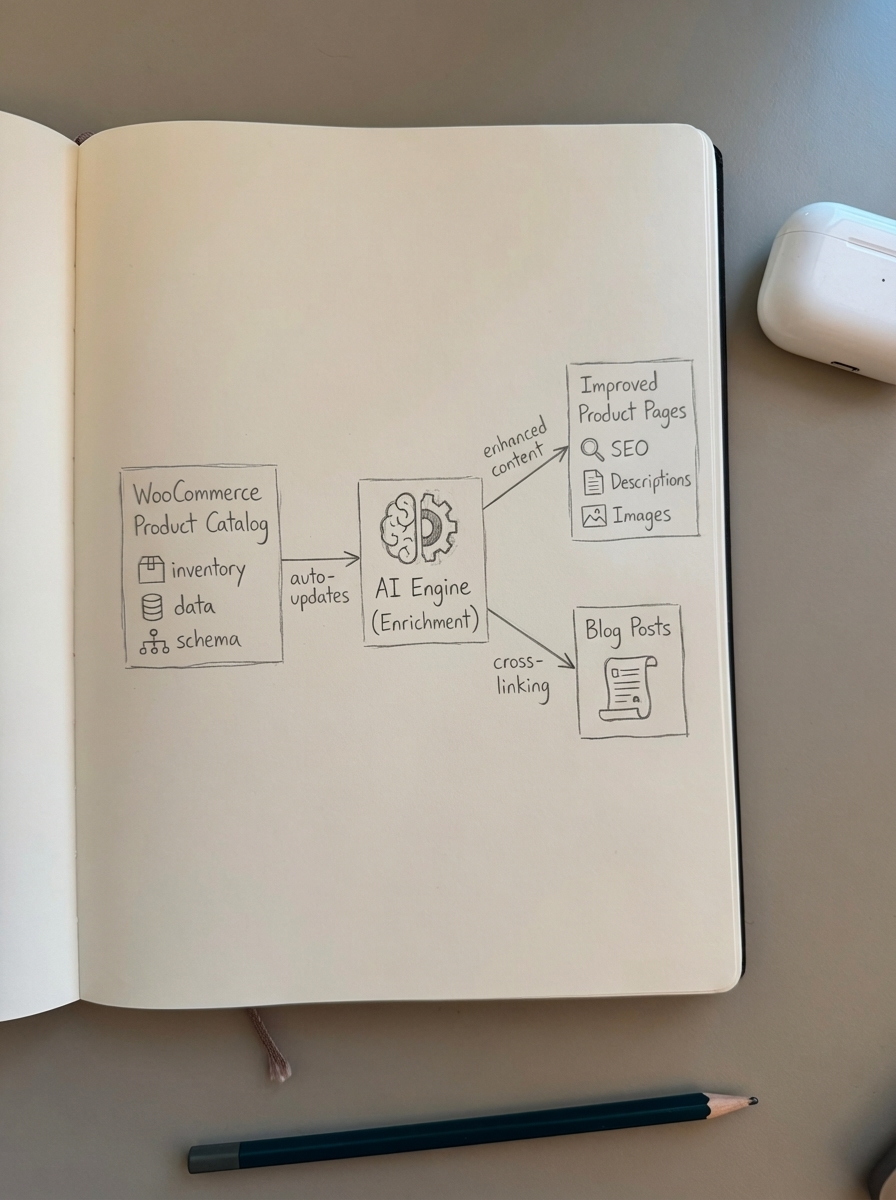
ContentGecko is purpose-built for this. The platform syncs directly with your WooCommerce catalog via the WordPress Connector plugin, monitors product changes (prices, stock status, URLs, descriptions), and automatically updates blog content and schema markup when your catalog changes.
ContentGecko clients report up to 10x increases in monthly organic traffic without expanding their teams. Automated reporting reduced SEO report creation time from 15 hours to under 2 hours for a B2B SaaS marketing team.
Viralsweep gained 2,172 additional monthly clicks and achieved top 10 rankings within a week using AI-powered content automation. An ecommerce retailer using ContentGecko’s intent-based clustering achieved a 43% increase in organic traffic and 27% rise in qualified leads.
Key capabilities for WooCommerce AI SEO tools
Product page optimization
AI should generate unique, conversion-focused product page content that includes target keywords, addresses customer questions, and updates when product specs change.
Look for tools that can generate unique descriptions for product variations, pull attributes from WooCommerce data (color, size, material), update meta descriptions when prices change, and create schema markup that reflects current inventory status.
The WooCommerce Product Image Generator takes this further by creating lifestyle images with AI. Stores report 19% increases in PDP conversion and 8% drops in returns after adding context images.
Meta tag and schema automation
Manual meta description writing doesn’t scale past 100 products. AI should generate title tags and meta descriptions that include primary keywords, brand names, and compelling CTAs while staying within character limits.
For schema, properly implemented structured data can trigger rich product results leading to 35-45% higher CTRs. Only 32% of WooCommerce sites implement review schema correctly, and most plugins generate basic Product schema without handling reviews, offers, or inventory status.
Your AI tool should automatically add Product, Offer, AggregateRating, and BreadcrumbList schema based on current catalog data – not static markup you set once and forget.
Content generation for category and blog pages
Category pages rank for high-intent commercial keywords but most stores treat them as filtered product grids with no unique content. AI can generate category descriptions that target buyer intent without creating thin content issues. The free ecommerce category page optimizer identifies optimization opportunities by analyzing your store’s category structure and suggesting more specific, buyer-friendly titles.
For blog content, look beyond generic AI writing tools. You need catalog-aware content that naturally links to relevant products, updates when those products change, and targets keywords your competitors miss.
ContentGecko’s approach to dual-structured content – concise AI-friendly summaries paired with detailed information – optimizes for both traditional search and AI platforms. SEO has 95.7% market share with 5.6% YoY growth, while AEO (AI Engine Optimization) has 4.3% market share with 125.8% YoY growth.
The free AI SEO content writer analyzes SERPs, researches facts using Perplexity and DeepSeek R1, creates SEO briefs, and fact-checks content with proper citations – distinguishing it from generic ChatGPT outputs.
Image SEO automation
Images account for approximately 61.3% of a web page’s download time, and ~30% of U.S. shoppers refuse to purchase from stores featuring low-quality product images. Sites with unoptimized product images can see up to a 25% drop in search rankings.
AI should handle alt text generation based on product attributes, filename sanitization (product-123.jpg becomes “blue-cotton-t-shirt.jpg”), schema image URL validation, and compression with format optimization (WebP with JPEG fallback).
ContentGecko reduced manual SEO work by 11 hours per week for 78% of WooCommerce stores with 22% average organic image traffic growth in 6 months through automated image optimization.
Integration workflows and implementation
Plugin-based integration
Most WooCommerce stores start with an SEO plugin (Yoast, Rank Math, AIOSEO) that adds basic optimization features. These work well for stores under 500 products but hit limits as catalogs grow.
Plugin conflicts create problems. Multiple SEO plugins can output duplicate schema, conflicting canonical tags, or redundant sitemaps. I’ve seen stores with Yoast, Rank Math, and Schema Pro all active simultaneously, each adding their own Product schema – Google ignores all three.
Manual overhead persists even with AI features. You’re still clicking through product pages one at a time to generate descriptions or optimize images. Bulk operations require paid tiers and often break on large datasets.
Catalog drift is inevitable. Your plugin generates perfect meta descriptions in January. By March, 30% of your products have new prices, 15% are out of stock, and 8% have been discontinued. The meta descriptions haven’t updated.
API and webhook integration
Better solutions integrate at the catalog level via WooCommerce REST API or webhooks. This enables real-time updates when products change, bulk operations across your entire catalog, centralized management outside WordPress admin, and integration with inventory systems, ERPs, and PIMs.
ContentGecko uses this approach with the WordPress Connector plugin, which acts as a secure bridge with hashed API keys, HMAC authentication, and optional IP allow-listing. It exposes product categories, inventory, images, and metadata while respecting WordPress capability checks.
When you update a product price in WooCommerce, ContentGecko automatically regenerates affected blog posts, updates schema markup, and refreshes meta descriptions – no manual intervention required.
Automation and monitoring workflows
The most effective AI SEO workflows combine generation with ongoing monitoring:
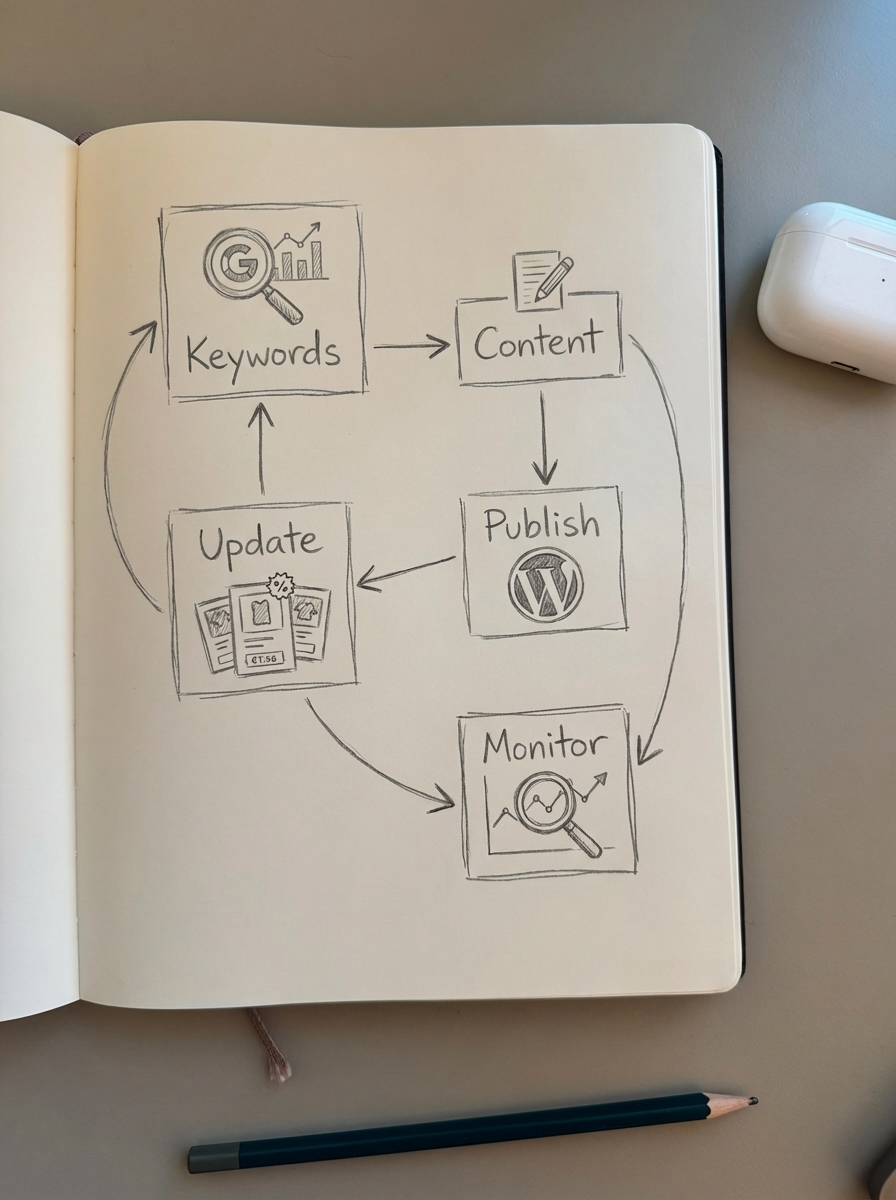
Content planning starts with AI identifying keyword gaps using tools like the free SERP keyword clustering, which groups keywords by search result similarity and can cluster up to 200 keywords in the free version (or 20,000 keywords with the premium algorithm that’s 7x faster).
Generation follows. AI writes content, generates meta tags, creates schema, and optimizes images based on current catalog data.
Publishing happens automatically to WordPress with proper URL structure, breadcrumbs, and internal links.
Monitoring provides real-time alerts for ranking fluctuations, traffic pattern shifts, competitor movements, and technical issues.
Updates trigger when SKUs, prices, stock, or URLs change. AI automatically refreshes affected content.
This workflow is why ContentGecko clients see results. The platform continuously checks for issues, refreshes content when products change, and tracks rankings, CTR, conversions, and SKU performance without manual reporting.
Selection criteria: What to look for
Catalog integration depth
Can the tool read your full product catalog? Does it understand variants, attributes, stock status, and pricing? Or does it just see generic WordPress post data?
Test this by checking if the AI can differentiate between product variations (Small Blue vs Large Red), reference current inventory status in content, update automatically when you discontinue a product, and link to the correct variant URLs in blog posts.
Technical SEO coverage
WooCommerce-specific technical SEO includes dozens of details: faceted navigation canonicalization, product variation schema, proper URL structure, pagination handling, and more.
Ask vendors how they handle duplicate content from filtered views, whether they can generate proper canonical tags for product variations, if they support multi-criteria review schema, and how they manage XML sitemaps for large catalogs.
Most general-purpose AI SEO tools will stumble here because they weren’t built for ecommerce.
Content quality and uniqueness
Run a test: Have the AI tool generate descriptions for three similar products (e.g., “Men’s Blue T-Shirt Small,” “Men’s Blue T-Shirt Medium,” “Men’s Blue T-Shirt Large”).
If the content is 90% identical with only the size changed, you have a thin content problem. Google will index all three pages but won’t rank any of them well.
Better AI understands product attributes and generates genuinely different content. Compare “This blue t-shirt is available in large size. Made from 100% cotton. Machine washable” to “Our roomiest fit for layering or a relaxed look. This large blue t-shirt offers extra shoulder width and longer sleeves compared to our standard fit. The heavyweight 100% organic cotton fabric (6.1 oz) provides structure without stiffness. Ideal for builds over 6’2” or customers who prefer generous sizing.”
Automation and maintenance
How much manual work remains after setup? Be specific: When you add 50 new products, does the AI automatically generate content for them? When you change a product price, does it update meta descriptions automatically? When a product goes out of stock, does it adjust blog posts that recommend it? When you run a sale, does it refresh content to reflect current pricing?
The platform’s prompt engineering capabilities reduce content creation time by 40-70% and improve keyword clustering efficiency by up to 95% – but only if the automation actually works without constant supervision.
Analytics and ROI tracking
“More content” doesn’t matter if it doesn’t drive revenue. Your AI SEO tool should show organic traffic by page type (category vs product vs blog), conversion rates from organic sessions, revenue attributed to SEO content, which products get the most organic visibility, and keyword rankings with search impression trends.
The ecommerce SEO dashboard displays standard Google Search Console metrics but breaks them down by page type. You can use the SEO ROI calculator to quantify impact on content production efficiency, keyword coverage, organic traffic growth, and conversions.
Where ContentGecko fits in the AI SEO landscape
Most AI SEO tools solve one problem: they generate content, manage technical SEO, or provide analytics. ContentGecko is built for the full ecommerce SEO workflow.
Catalog-first architecture means everything starts with your WooCommerce product data. ContentGecko syncs categories, products, variations, inventory status, and pricing via secure API. When products change, content updates automatically.
Automated content planning happens when the platform analyzes your catalog, identifies keyword opportunities competitors miss, and creates content strategies around how-tos, listicles, and buyer guides that naturally link to relevant products.
Technical optimization – proper structured data, canonical tags, internal linking, breadcrumbs, and URL structure – happens automatically. No plugin conflicts, no manual schema editing, no broken canonical chains.
Ongoing maintenance handles discontinued products, price changes, and stock-outs. ContentGecko monitors these changes and updates affected content automatically – the only platform that does this at scale.
Dual optimization for SEO and AI search matters because LLMO-specific KPIs tracking includes citation frequency in AI responses, AI search traffic sources, and content retrieval rates in LLM tools. ContentGecko optimizes for both traditional Google search and emerging AI platforms.
The platform offers tiered pricing based on catalog size: Starter (up to 1,000 products), Professional (up to 10,000 products), and Enterprise (10,000+ products). All plans include automatic blog writing and updating, product catalog sync via API, product images and smart links in blog posts, SEO analytics, and support (email for Starter, priority for Professional, 24/7 dedicated Slack for Enterprise).
TL;DR
AI for WooCommerce SEO splits into general WordPress SEO plugins (Yoast, Rank Math, AIOSEO), standalone AI platforms (Clearscope, Surfer, Semrush), and catalog-aware solutions built for ecommerce.
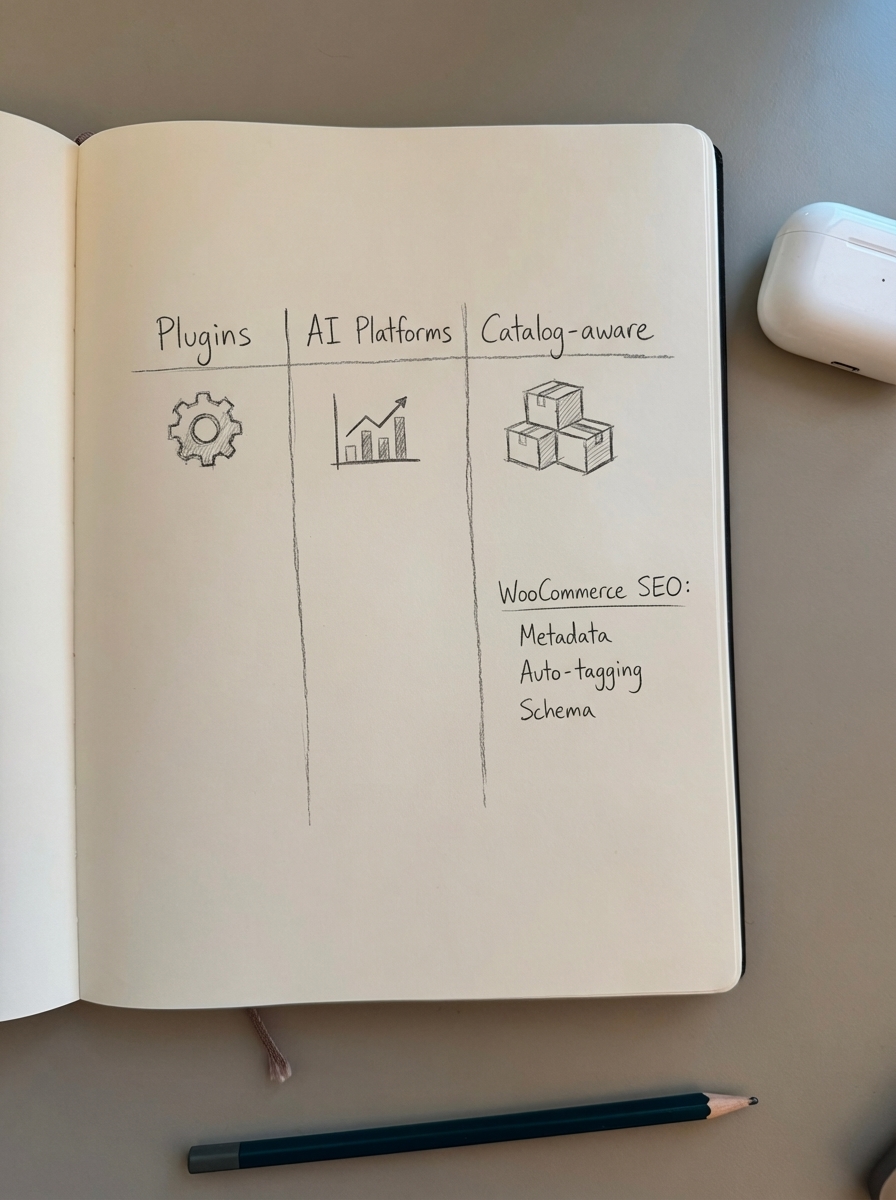
Plugins handle basic optimization but require manual work and struggle with catalog drift. Standalone platforms excel at content quality but don’t integrate with WooCommerce product data. Most tools force you to choose between AI-powered content and technical ecommerce SEO.
ContentGecko combines catalog-synced content generation, technical optimization, and automatic maintenance. It monitors your product catalog, generates conversion-focused content that updates when products change, handles complex ecommerce SEO details (faceted navigation, variation schema, proper canonicals), and tracks revenue impact – not just rankings.
For stores under 500 products, start with Rank Math for technical SEO and experiment with AI writing tools for blog content. For catalogs over 1,000 products, manual maintenance becomes unsustainable and catalog-aware automation delivers measurable ROI. Use the free category optimizer or keyword clustering tool to identify quick wins, then evaluate whether your current workflow can scale or if you need purpose-built automation.