


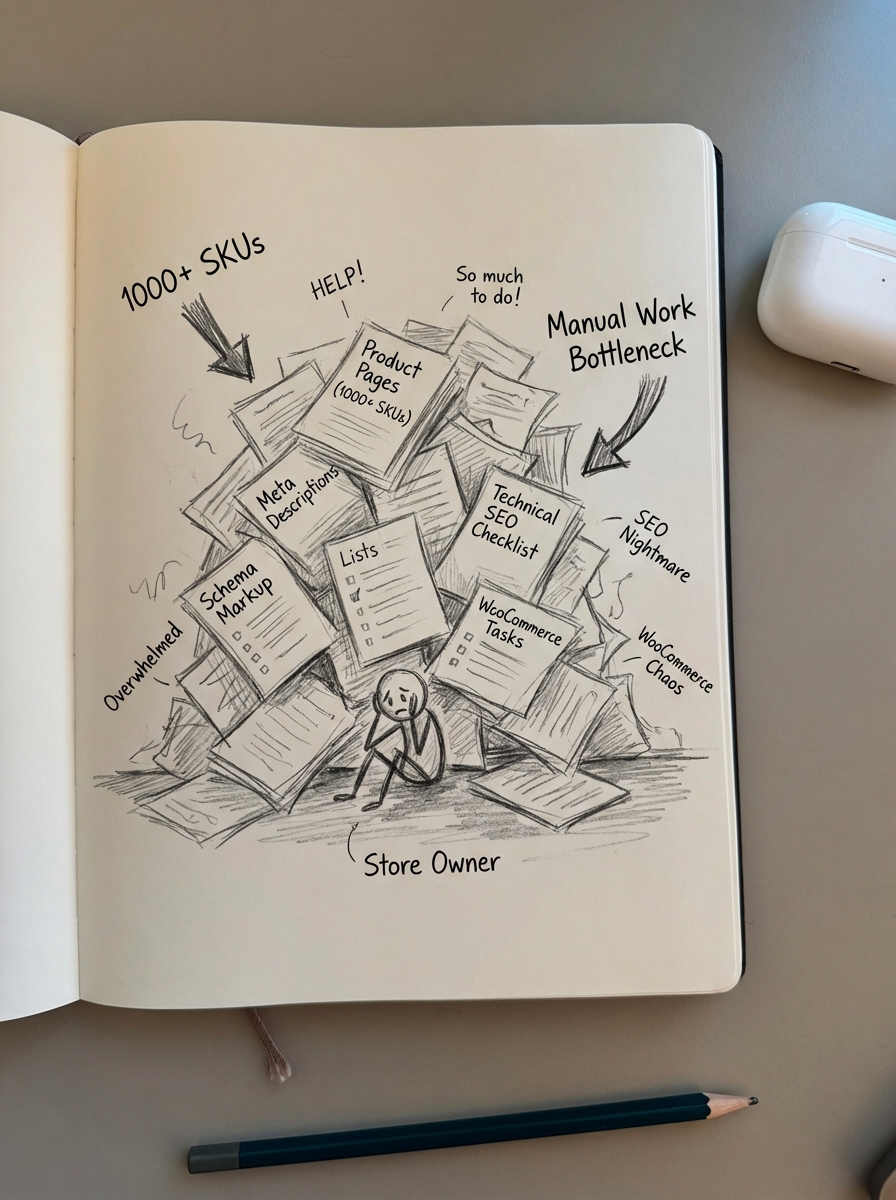
Outsourcing your SEO and content operations is the only way to scale once you move past the initial setup of your WooCommerce store. If you are still manually writing meta descriptions or trying to fix schema errors yourself while managing a catalog of over 500 products, you aren’t running a business – you are performing a set of content production bottlenecks that will eventually stall your growth.
When to outsource your SEO and content
I have seen many founders wait too long to outsource because they fear losing control over their brand voice. The reality is that the cost of your time spent on manual execution is almost always higher than the cost of a specialist or an automated system. You should look into outsourcing when you hit any of the following three indicators.
The 1,000-SKU inflection point is usually the first sign. Managing SEO for a handful of products is easy, but managing a large-scale catalog requires a systematic approach to technical SEO fundamentals like faceted navigation and canonical management. Without an automated way to handle these technical layers, your site health will rapidly decline.
Traffic plateaus are the second major indicator. Most merchants only optimize their product pages and hit a ceiling within 12 months. Product pages are great for capturing low-funnel branded searches, but to grow further, you need top-of-funnel content like buying guides and topic clusters that capture informational search intent. Finally, you must outsource when your strategy becomes purely reactive. If you only look at your rankings when sales dip, you need a dedicated partner or platform to provide consistent SEO reporting and proactive updates.
Models for outsourcing ecommerce SEO
There is no one-size-fits-all model for outsourcing, and your choice should depend on your catalog size and internal resources.
- Freelance Specialists: These are best for specific tasks like high-quality content briefs or fixing a one-off technical migration. While they are cost-effective, they are difficult to scale as your catalog grows.
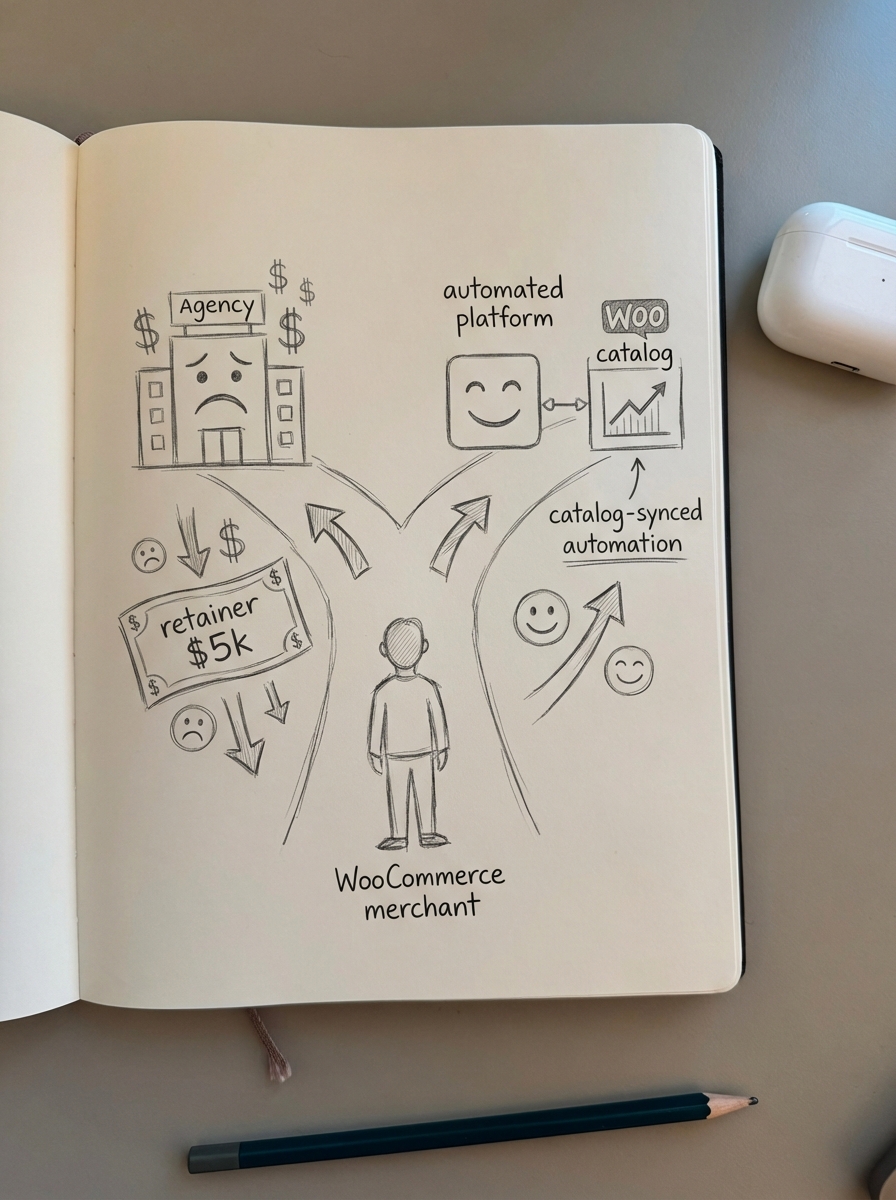
- Agencies: Agencies are often the choice for enterprise-level strategy and high-touch management. They provide a full team but frequently come with high retainers ($3k–$10k+ per month) and a “black box” approach to reporting that hides true performance.
- Automation Platforms: This is where the market is moving for WooCommerce stores. Platforms like ContentGecko offer a hybrid approach by automating the planning and execution of catalog-synced content. This ensures your blog stays updated as your SKUs and prices change, removing the manual labor of outsourcing while maintaining brand control through style guide ingestion.
Common risks and how to avoid them
Outsourcing isn’t a “set it and forget it” solution. I’ve seen many stores get burned by agencies that focus on “thought leadership” content that never ranks, or worse, “SEO-optimized” fluff that hurts the user experience. Many agencies will recommend creating thousands of thin pages to “capture more keywords,” but in ecommerce, this bloat is a fatal mistake. Most stores would benefit more from optimizing their category names than from adding 100 low-quality blog posts. Duplicate pages and bloated sitemaps confuse Google and waste your crawl budget.
Another significant risk is relying on inaccurate data. Most agencies use third-party keyword tools to justify their work, but these databases are often too small to represent real-time ecommerce opportunities. At ContentGecko, we prefer SERP-based keyword clustering because it looks at what Google is actually rewarding right now, rather than relying on outdated volume estimates. Furthermore, avoid traditional link building unless it is done at an elite level; for most stores, the expense of high-quality outreach is rarely profitable compared to the returns of better category structures.
Evaluating costs and ROI
When you outsource, stop looking at the price per word or the monthly retainer. You should instead focus on your cost per acquisition (CAC) and the potential ROI of your SEO investment. A typical agency retainer might cost $5,000 a month, and if that agency only produces four blog posts, you are paying $1,250 per post – a cost that is difficult to justify for most growing brands.
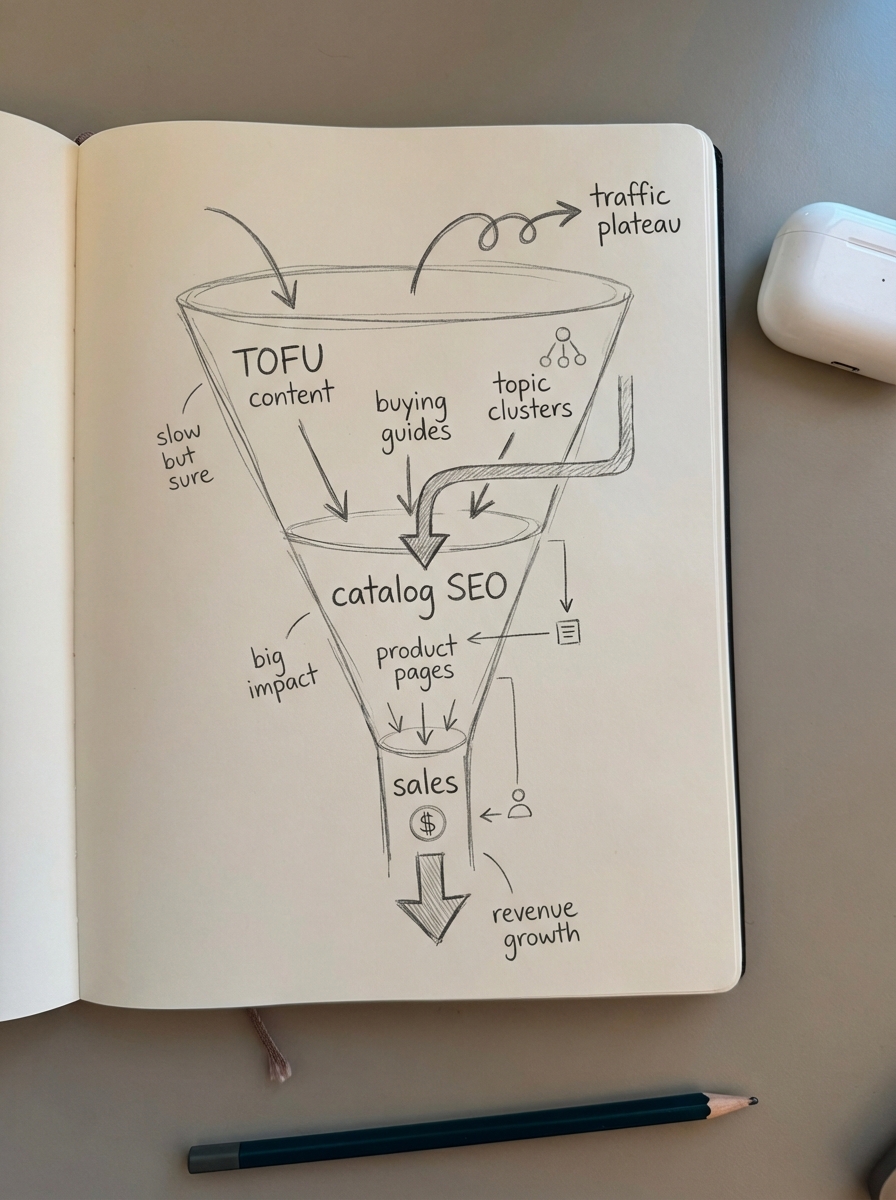
In contrast, an automated platform can plan, write, and update dozens of articles for a fraction of that cost, synced directly to your WooCommerce product catalog. The true ROI in ecommerce SEO comes from “low-hanging fruit” like category page optimization and internal linking. If an outsourced partner isn’t talking about your category hierarchy, they aren’t looking at your biggest revenue drivers.
How to manage external providers effectively
If you choose to work with a human agency or freelancer, you must provide a rigorous content quality assurance process to ensure the output matches your brand standards.
- Demand a Dashboard: Don’t settle for a static PDF report at the end of the month. You need an ecommerce SEO dashboard that separates performance by page type, allowing you to see exactly how categories, products, and blog posts are contributing to your revenue.
- Use Detailed Briefs: Never let a writer “just write.” Every piece of content should follow a specific content production workflow that includes intent mapping and primary keyword targets.
- Automate the Routine: Don’t pay an agency to manually check for broken links or update product prices in blog posts. Use the ContentGecko WordPress Connector to sync your catalog so your content updates itself when your inventory or pricing changes.
Why automation is the future of ecommerce SEO
The old model of outsourcing involved a lot of back-and-forth emails, slow approval cycles, and high costs. In 2026, that model is dying. AI and automation have leveled the playing field, allowing smaller WooCommerce stores to perform like enterprises by adopting these tools quickly.
By using a fully automated SEO content platform, you eliminate the human error associated with outsourcing. You get content that is catalog-aware, conversion-focused, and continuously updated. It’s not just about producing content; it’s about maintaining a living SEO ecosystem that drives sales without the overhead of a traditional agency.
TL;DR
Outsource when your manual SEO work hits a 1,000-SKU limit or your organic traffic plateaus. Avoid the “thought leadership” trap and focus on category-level optimization, which offers the best ROI for ecommerce. While agencies can help with high-level strategy, catalog-synced automation via ContentGecko is the most scalable way for WooCommerce merchants to manage content without the high costs and quality risks of traditional outsourcing.