


To dominate competitive retail categories, you need both quality and high volume; publishing one “prestige” post a month will not build the topical authority required to outpace established competitors. In my experience, the “quality over quantity” debate is a false dichotomy that leads to stagnation. For most growing WooCommerce stores, I recommend publishing 2 to 4 times per week to maintain a high baseline of utility for the user and maximize search visibility across the entire buyer journey.
Why publishing frequency is a competitive moat
Most merchants mistakenly believe their product pages will do the heavy lifting for organic growth. In reality, product and category pages only capture a small slice of transactional intent. To reach the vast majority of users who are still in the “problem awareness” or “solution comparison” phases, an active blog is mandatory. Frequency serves as a technical signal to search engines; the more often you publish, the more frequently Googlebot crawls your site. For stores managing large catalogs, this increased crawl frequency ensures that price changes, inventory updates, and new arrivals are reflected in search results much faster.
Beyond the technical benefits, a high publishing cadence allows you to build WooCommerce topic clusters rapidly. I have seen category pages move from position 12 to position 3 simply because the store surrounded that category with a dozen specific, helpful blog posts. This strategy builds the topical authority necessary to rank for broad, high-volume terms. Furthermore, a high volume of content generates more data in your ecommerce SEO dashboard. By analyzing more impressions and clicks, you can identify which niche topics are gaining traction and double down on what is already working.
According to research from HubSpot, companies that publish 16 or more posts per month receive nearly 3.5 times more traffic than those publishing fewer than four. While this includes B2B data, the principle of “market share of voice” is arguably more critical in the crowded retail space where brand recall is linked to how often you appear in a consumer’s search path.
Recommended publishing cadence by store size
Your publishing frequency should scale in lockstep with your catalog size and revenue goals. If you are managing 10,000 SKUs but only have a handful of blog posts, you have a massive content production bottleneck that is actively preventing your products from being discovered.
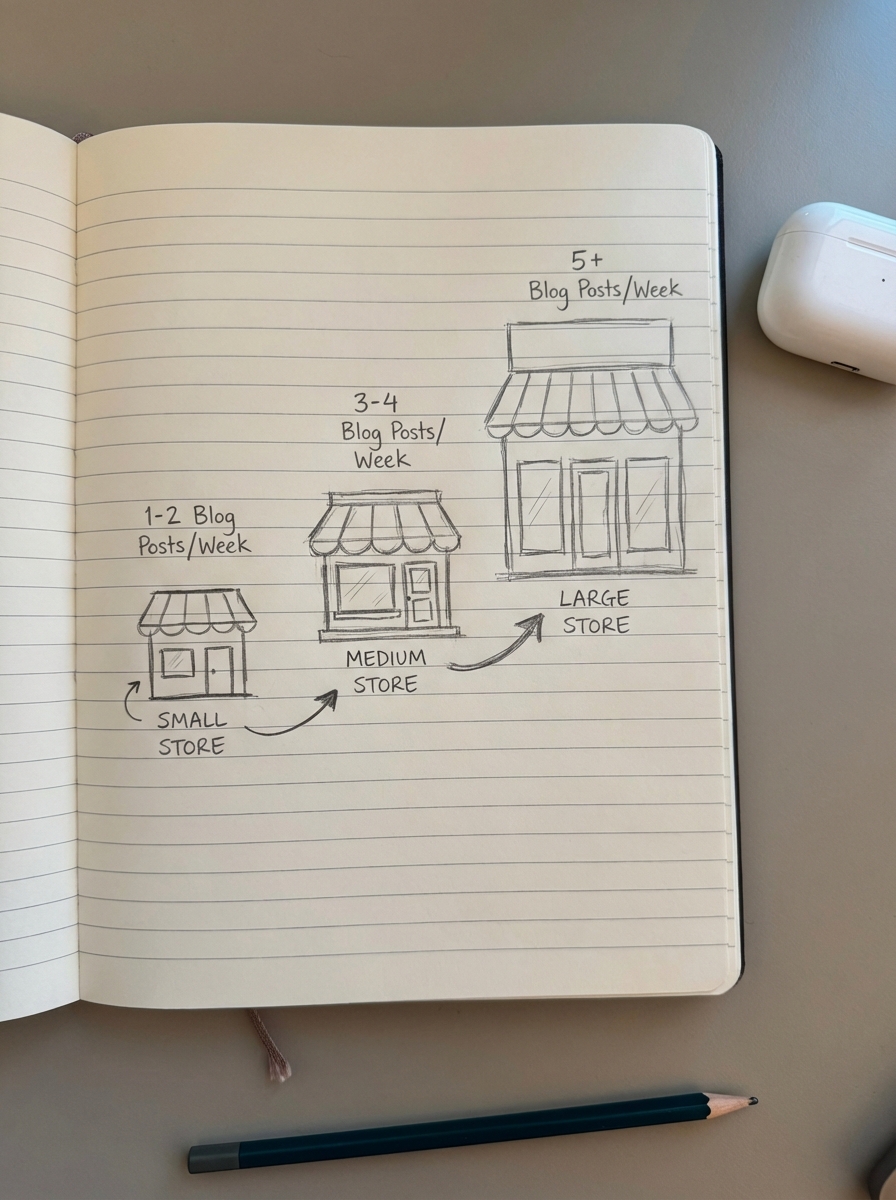
Starter stores (<1,000 products)
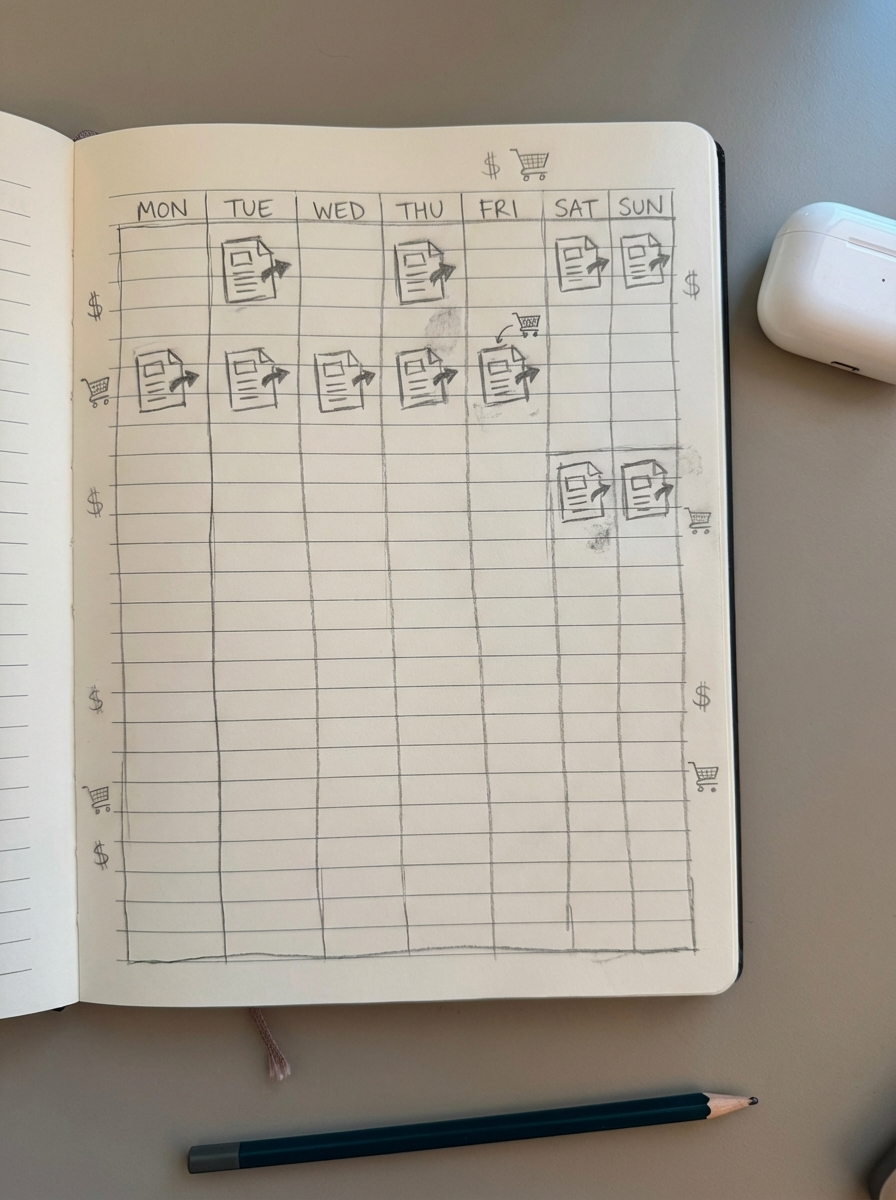
For growing stores with smaller catalogs, the goal is to build a baseline of authority and capture long-tail keywords. I recommend a cadence of 1 to 2 posts per week. At this stage, focus on the “low-hanging fruit,” such as buying guides and how-to articles that directly support your top-selling categories. Maintaining this rhythm is easier when using a content calendar template to stay organized. If manual writing feels like a barrier to entry, an AI SEO content writer can help you get a viable draft live quickly, allowing you to iterate on the content once you see it gaining traction in search results.
Professional stores (1,000–10,000 products)
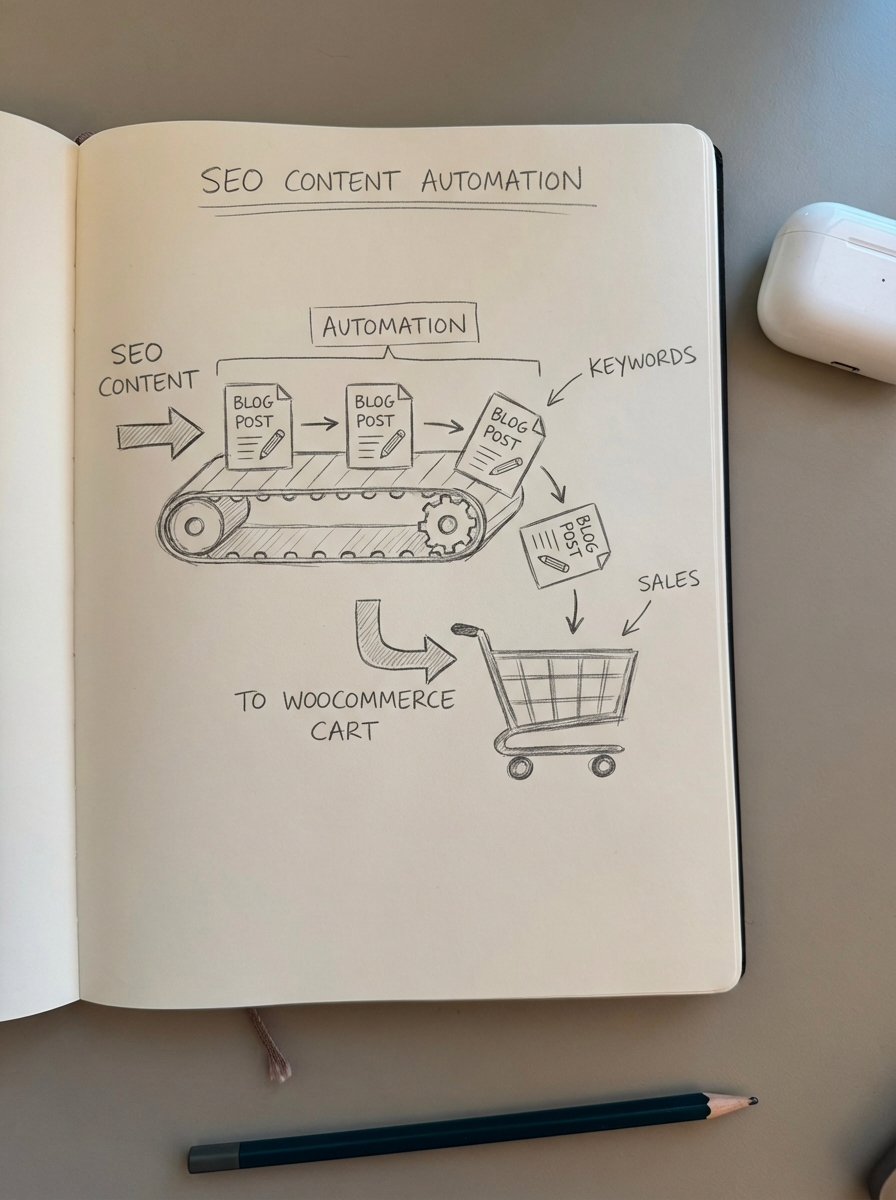
Once you have established authority, you must increase your velocity to blanket your niche and capture mid-funnel comparison traffic. At this scale, 3 to 5 posts per week is the ideal target. Manual content production often breaks at this volume, making it necessary to implement a formal content quality assurance process to ensure your brand voice remains consistent. This is the inflection point where SEO content automation delivers its highest ROI by syncing your blog content directly to your live inventory and category hierarchy.
Enterprise stores (10,000+ products)
Large retailers with massive catalogs should aim for daily publication, or even multiple posts per day. Leaders in the space, like REI or Wayfair, treat their blogs like digital magazines to train search engines to view them as the definitive source for their entire industry. For these stores, I advocate for a “catalog-aware” strategy where articles are not static; they should update automatically based on SKU availability and pricing changes. At this volume, automation is not just a luxury – it is the only way to remain relevant in a landscape increasingly influenced by AI-driven search snapshots.
Quality vs. quantity: Addressing the “spam” objection
A common objection I hear from marketing leaders is the fear that Google will penalize high-volume or AI-assisted content. This stems from a misunderstanding of how the Helpful Content System operates. Google does not penalize volume; it penalizes unhelpful, “thin” content that fails to satisfy search intent. If you publish dozens of articles that merely rewrite product descriptions without adding value, your rankings will suffer.
However, if you utilize advanced keyword research to identify unique intents – such as a specific sizing guide or a comparison table – Google will reward that volume. I have found it far more effective to launch an “MVP” version of an article and then use SEO content audits to monitor performance. Once a post hits the second page of search results, you can then justify the human editorial time needed to polish it and push it into a top-three position.
How to maintain a high cadence without burnout
The primary reason in-house teams fail to maintain frequency is that they treat every blog post like a definitive industry manifesto. For ecommerce, consistency is more valuable than individual perfection. You can streamline your workflow by grouping keywords by intent into core clusters. This allows you to plan an entire quarter of content in a single afternoon using a keyword clustering tool to find overlapping search results.
If your team cannot hit at least one post per week, it is time to consider outsourcing SEO content or using a platform like ContentGecko that integrates with your store via a WordPress connector. Furthermore, a high cadence should not just focus on new posts. Orbit Media’s blogging studies indicate that bloggers who update older content are 2.8 times more likely to see strong results. For a WooCommerce merchant, this means refreshing your “Best of” lists and buyer guides as new product models arrive or inventory shifts. Using specialized WooCommerce SEO tools to automate these refreshes keeps your content accurate without requiring manual labor.
TL;DR
Publishing frequency is the engine that drives organic growth for ecommerce. For growing WooCommerce stores, I recommend aiming for 2 to 4 posts per week to build the topical authority needed to capture top-of-funnel traffic. Use SERP-based keyword clustering to plan your content strategy and lean on specialized automation tools to handle the heavy lifting of catalog synchronization. If you are not posting at least once a week, you are not just standing still; you are falling behind competitors who are aggressively expanding their digital footprint.