
January 20, 2026
Competitor keyword research for ecommerce

Most ecommerce managers waste hundreds of hours chasing search volume metrics that are fundamentally broken. The real edge in competitor keyword research isn’t finding the highest-volume terms; it’s uncovering the specific clusters your competitors are using to dominate category pages and validating that intent with your own first-party data.

The trap of third-party keyword data
If you are relying solely on SEMrush or Ahrefs to tell you what to target, you are already behind. I’ve seen countless WooCommerce stores fail because they chased a “high volume” keyword that turned out to be a ghost in actual Google Search Console data.
Third-party databases are simply too small to accurately represent the long-tail complexity of modern ecommerce. They often miss SKU-level shifts and seasonal trends until it’s too late. While these tools provide a useful baseline, the data is often off by a significant margin. I’ve managed catalogs where the “estimated volume” from a tool was less than 10% of the actual traffic we captured.
Instead of treating tool data as gospel, use it as a starting point for advanced keyword research. Your goal is to identify the intent your competitors are satisfying, not just the strings of text they rank for. We focus on the “why” behind the ranking rather than the “what” provided by a dashboard.
Identify your true SERP competitors
Your business competitors aren’t always your SEO competitors. While you might be fighting a local boutique for physical market share, your SERP competitors are likely Amazon, Pinterest, and niche review blogs. I recommend split-testing your competitor list into two distinct buckets.
Direct rivals include other WooCommerce or Shopify stores selling the exact same catalog as you. Authority rivals are large marketplaces or publishers that dominate the informational queries. To find these, search for your top five most profitable category names. The sites that consistently appear in the top three results are your real targets for a competitor keyword gap analysis. This allows you to see where these giants are vulnerable – usually in specific, niche long-tail segments they can’t address with generic templates.
The ecommerce keyword harvest
Extracting the “paid intent” signal is the fastest way to validate commercial viability. PPC data bypasses the guesswork of organic volume because if a competitor is consistently bidding on a keyword in Google Ads, it’s because that keyword converts. I look at which terms competitors are spending money on and, more importantly, where they send that traffic. Usually, the highest ROI lies in finding low competition keywords that have high commercial intent but lower organic difficulty. If they are sending paid traffic to a specific category page rather than a homepage, you know that category is a high-margin winner.
Map keywords to the WooCommerce hierarchy
The biggest mistake I see is trying to rank product pages for broad terms. In ecommerce, optimizing category names is far more important than tweaking individual product pages. Broad, plural terms like “men’s waterproof hiking boots” should always map to category pages. Specific, singular, or SKU-based terms belong on product pages.
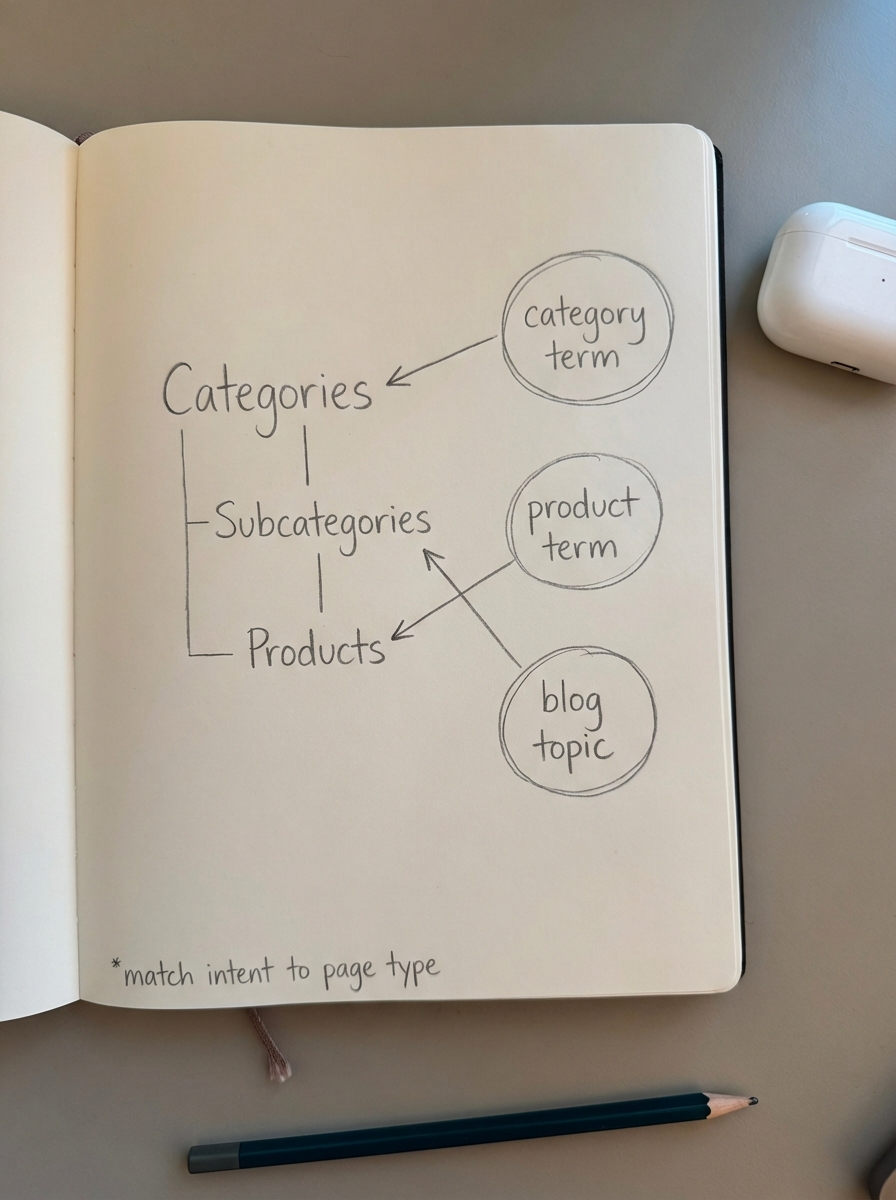
Informational, “how-to,” or “best of” terms are reserved for the blog. If your competitor ranks for a “best of” list, they are capturing users at the top of the funnel. You can counter this by performing WooCommerce keyword research to find the gaps in their informational content and creating buyer guides that link directly back to your high-margin categories.
Use SERP-based clustering to avoid cannibalization
Once you have a massive list of competitor keywords, you must determine which terms can be targeted on a single page and which require separate URLs. I always use SERP-based clustering for this process. If Google shows 70% of the same URLs for two different keywords, they belong on the same page. If the results are different, you need two separate pages to satisfy the intent.
You can use a free SERP keyword clustering tool to automate this. This prevents “bloated website” syndrome, a common technical SEO mistake where multiple pages compete for the same intent. By grouping keywords effectively, you ensure each URL on your WooCommerce store has a distinct job to do, increasing your topical authority without creating duplicate content.
Validating with first-party data
Before committing your budget to a new category or a massive blog campaign, check your own Google Search Console data. Look specifically for “impressions without clicks.” If you are already getting impressions for a competitor’s top keyword despite not having a dedicated page for it, that is a massive green light.
This data indicates that Google already associates your domain with that specific entity or concept. In my experience, creating a dedicated page for a term you already “accidentally” rank for on page three is the fastest way to jump into the top five. It’s much safer to double down on these existing signals than to chase a high-volume keyword where you have zero historical impressions.
Moving from research to execution
Research is useless without a sustainable workflow. For most WooCommerce stores, the basics of SEO – clean URLs, basic meta tags, and fast loading times – are already handled by plugins. The remaining opportunity is almost entirely in producing a high-quality blog that supports your catalog.
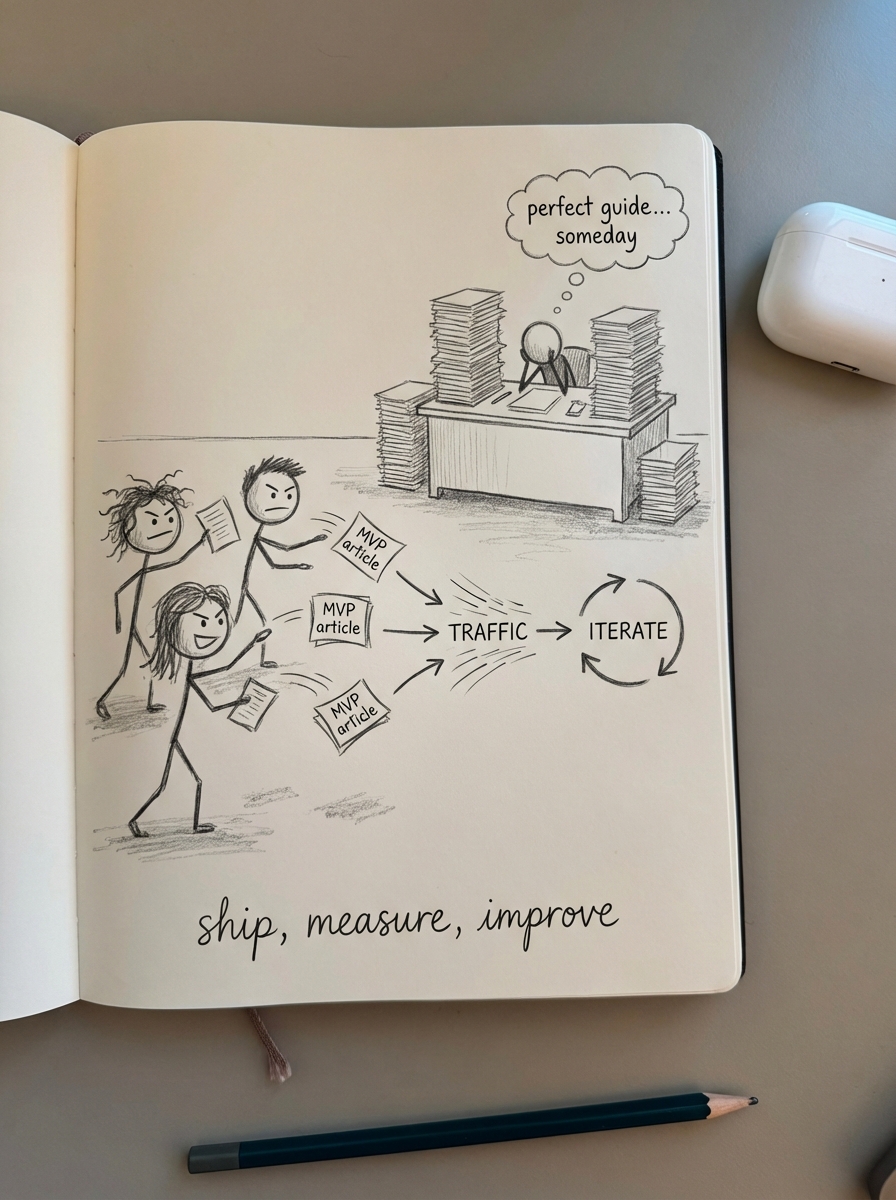
At ContentGecko, we believe in an MVP approach to content. Instead of spending months on a single thought-leadership piece that might never rank, we use AI to launch catalog-synced content quickly. If an article starts getting traction, we iterate and improve it. This is how you win in a competitive niche: by being faster and more data-driven than the competitors who are still manual-mapping keywords in a spreadsheet.
TL;DR
- Ignore third-party volume metrics as they are frequently inaccurate and miss long-tail opportunities.
- Prioritize keyword grouping via SERP overlap to prevent content cannibalization and site bloat.
- Focus the bulk of your SEO efforts on category pages rather than individual product pages.
- Validate all competitor findings using your own Search Console and Google Ads data before execution.
- Iterate your content strategy like a product by launching quickly and optimizing based on real traffic performance.