
January 20, 2026
Keyword research for SEO: A practical framework for ecommerce growth

Keyword research is not a hunt for words with the highest search volume; it is the process of mapping your product catalog to the way humans describe their problems and desires. If you are not aligning your WooCommerce store’s structure with real-world search behavior, you are building a storefront in a forest with no roads leading to it.
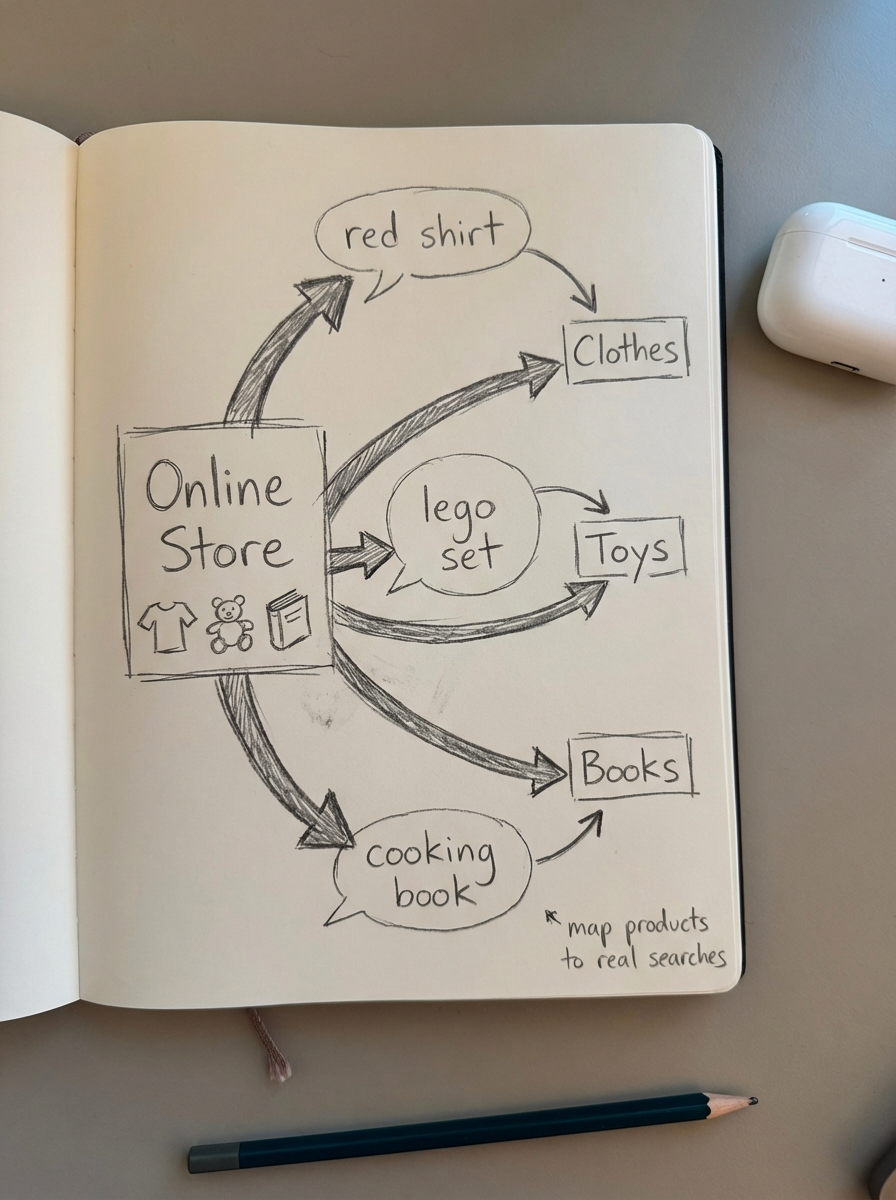
In my experience, most merchants approach this backward by looking for high-volume keywords first and then trying to force their products to fit. Real growth happens when you identify specific, high-intent queries that your catalog already solves and build the content to bridge that gap.
What keyword research actually is (and isn’t)
Keyword research identifies the terms people type into search engines like Google or generative tools like ChatGPT and Perplexity to find what you sell. In an ecommerce context, this requires a sharp distinction between a user looking for a solution and one who is just “kicking tires.” I have seen too many marketers waste thousands of dollars chasing high-volume informational terms that never convert.
Effective ecommerce research focuses on three pillars. First, intent mapping determines if a query belongs on a category page, a product page, or a blog post. Second, topical authority allows you to group related terms so search engines view your domain as a niche expert. Finally, catalog alignment ensures every keyword you target is supported by actual stock in your warehouse. For those looking for platform-specific execution, our WooCommerce keyword research framework covers these mapping strategies in detail.
The workflow: A step-by-step ecommerce framework
I do not rely solely on third-party tools because their databases are often too small to accurately represent specific ecommerce niches. Volume metrics are frequently off by a significant margin, making 3rd party keyword data essentially useless for precision targeting. Instead, I follow a first-party-first approach that prioritizes the data you already own.
Extracting seed keywords from first-party data
Your best keyword ideas are already in your possession. I always begin by leveraging Google Search Console for keyword research to find queries where the store has high impressions but low clicks. These are your low-hanging fruit – terms Google already associates with your site but needs a better reason to rank higher.
Beyond GSC, I look at internal site search logs to see the exact language customers use when they are ready to buy. Customer support logs are equally valuable; if shoppers frequently ask, “Will this coffee grinder work for espresso?”, you have just identified a high-intent long-tail keyword that should be the focus of a dedicated guide or product page update.
Competitor gap analysis and expansion
Once you have your seeds, look at what your competitors are ranking for that you are currently missing. This is not about copying their strategy, but about identifying a competitor keyword gap where they are satisfying a market need you have overlooked. I recommend looking beyond direct retail competitors to publishers, forums, and Reddit. If a specific problem is being discussed on Reddit, it is a prime candidate for a niche keyword research strategy that targets underserved segments.
Validating opportunity through intent and difficulty
Volume is a vanity metric that often leads to poor ROI. I would rather rank first for a long-tail keyword with 50 searches a month and a 25% conversion rate than a broad term with 5,000 searches and zero conversions. When validating keywords, you must manually assess the keyword difficulty and determine if you can realistically provide better value than the current top results.
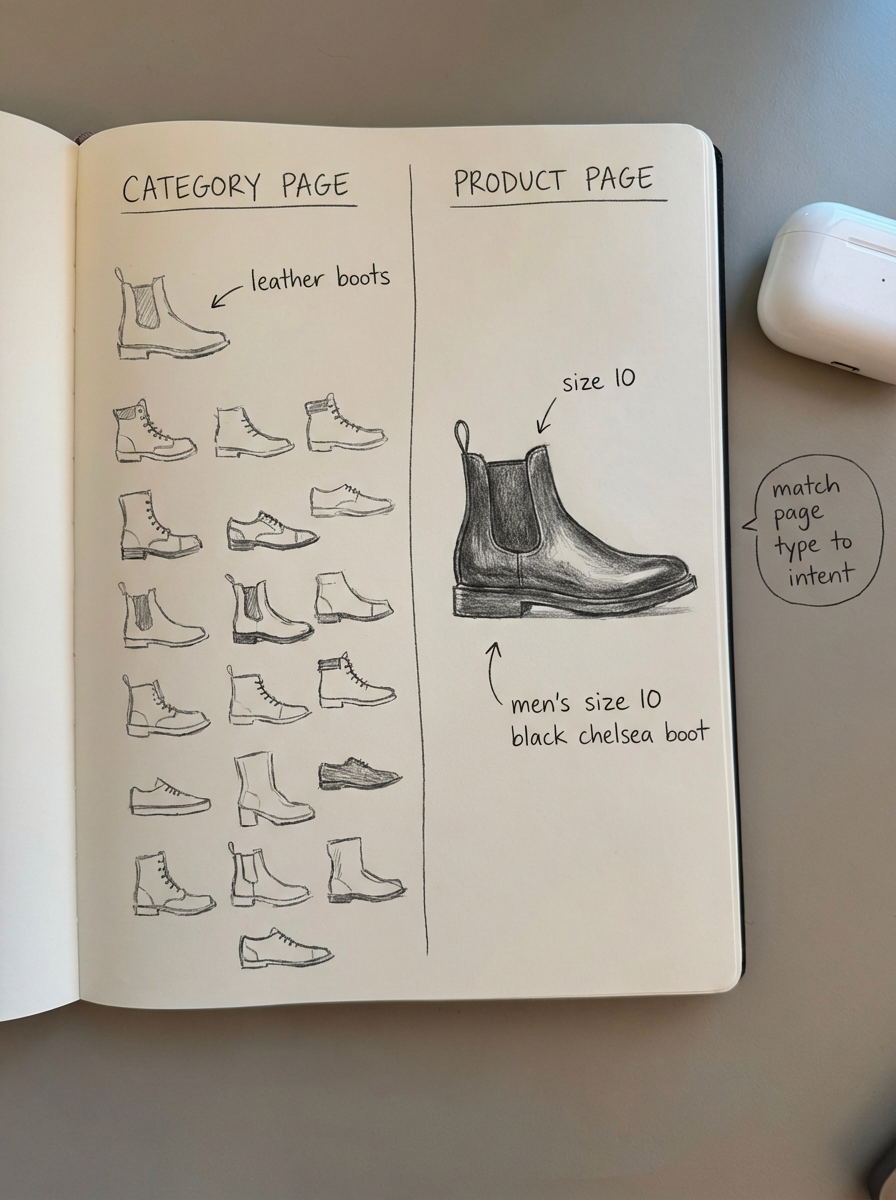
It is also vital to understand that in ecommerce, it is way more important to optimize category pages than product pages. If a keyword is plural, such as “leather boots,” it belongs on a category page. If it is highly specific, such as “Men’s size 10 black leather chelsea boot,” it belongs on a product page. You can use our ecommerce category optimizer tool to ensure your category names are specific enough to capture this intent.
Clustering for strategic efficiency
Never write one article for one keyword. Modern search engines are smart enough to understand synonyms and related concepts. I use keyword clustering to group related terms into a single “topic,” which prevents content cannibalization.
I strongly prefer SERP-based keyword clustering over semantic clustering. If Google shows the same top 10 results for two different keywords, those keywords belong in the same cluster because the search engine has already decided they satisfy the same intent. To automate this process for large lists, you can use our SERP-based keyword clustering tool.
A contrarian approach to execution
Most SEOs will tell you to spend weeks crafting the perfect “ultimate guide,” but I believe you should iterate content like a product. Launching an MVP allows you to test the waters before committing heavy resources to a topic.
Launching the content MVP
I recommend starting with an “MVP” version of your content to gauge search engine interest. By using an AI SEO content writer, you can get high-quality, factually accurate drafts live quickly. Once an article starts gaining traction and showing positive trends in your ecommerce SEO dashboard, you can then invest manual effort into polishing it and adding unique brand perspectives.

Preparing for the AI search shift
Traditional search is changing rapidly, with research showing that 58% of US consumers now use generative AI for product recommendations. Your keyword research must account for conversational queries. Instead of just targeting “best organic dog food,” your content needs to answer specific, complex questions like “Which organic dog food is best for a senior Labrador with joint pain?” AI-generated answer traffic grew 1,200% between July 2024 and February 2025, making this shift unavoidable.
Deprioritizing meta descriptions
It is 2026; you should not be wasting time writing manual meta descriptions. Google rewrites them the vast majority of the time to better match a user’s specific query. Focus that energy on your H1s, product schema, and helpful content instead. If you get the traditional SEO basics right, you are already halfway to optimizing for AI search engines.
Positioning the blog as a growth engine
Once your category and product pages are technically sound, the remaining organic opportunity for a WooCommerce store lies almost entirely in the blog. A catalog-synced blog that answers customer questions and links back to relevant SKUs is the most powerful growth tool you have. At ContentGecko, we automate this entire workflow – from initial keyword research to final publishing – ensuring your content stays in sync with your live inventory without the manual overhead.
TL;DR
- Prioritize category pages over product pages for broad, plural keywords.
- Focus on first-party data like Google Search Console and site search instead of inaccurate third-party volume metrics.
- Target high-intent long-tail keywords, which convert at roughly 25% compared to 12% for short-tail terms.
- Group keywords based on SERP overlap to avoid content cannibalization.
- Launch content as an MVP using AI tools and iterate based on actual performance data.
- Prepare for the decline of traditional search by optimizing for conversational, AI-driven queries.
- Stop writing manual meta descriptions and focus on H1s and structured data.