
January 20, 2026
What is keyword clustering in SEO

Keyword clustering is the practice of grouping search terms into thematic buckets to target multiple related keywords with a single page, ensuring your store covers entire topics rather than just individual phrases. For WooCommerce stores with thousands of SKUs, clustering is the baseline for a coherent site architecture. Without it, you are left with a bloated, unrankable mess of duplicate content that drains your crawl budget and confuses search engines.
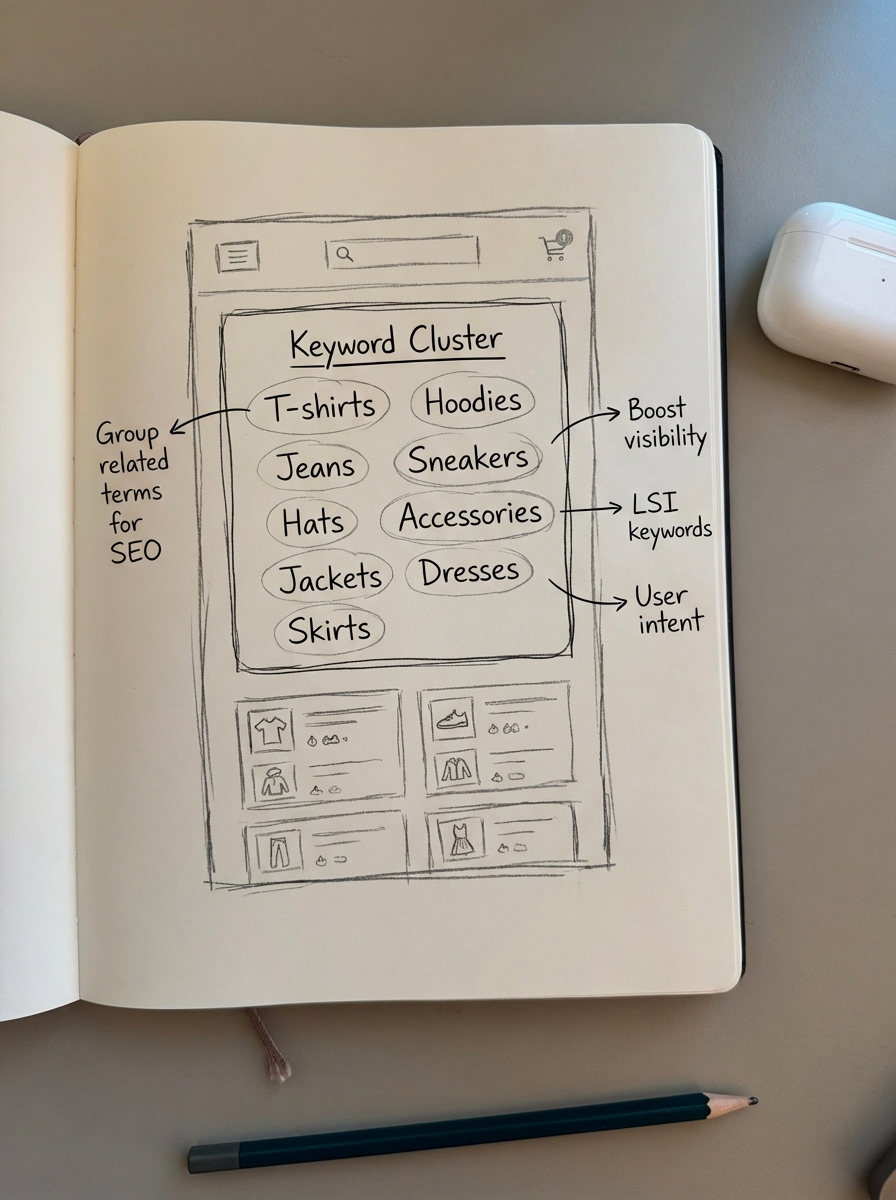
The bottom line is that modern search engines no longer rank pages based on a single keyword match. They rank based on topical authority and intent. If you want to scale a large catalog without creating thousands of competing URLs, you must master the art of grouping keywords into logical units that serve a specific user need.
Why keyword clustering is the only way to scale ecommerce SEO
If you are managing a large catalog, you cannot afford to treat every keyword as a unique page. The most common technical SEO mistake I see in high-SKU stores is a bloated website filled with duplicate pages that compete against each other for the same traffic. Without clustering, you might inadvertently create one page for “leather hiking boots” and another for “hiking boots made of leather.” To a search engine, these represent identical intent. Having both just splits your link equity and makes it harder for either page to reach the top three.
Clustering allows you to identify when multiple keywords should be served by a single URL. By grouping terms like “waterproof trail shoes,” “trail running footwear,” and “all-weather running shoes,” you can build one authoritative page that ranks for all of them. This is especially vital for WooCommerce topic clusters, where supporting blog content must reinforce your category pages without stealing their organic visibility.
SERP-based vs. semantic clustering: which should you use?
There are two primary ways to group keywords, and choosing the wrong one often leads to significant wasted effort. Semantic clustering uses Natural Language Processing (NLP) to group keywords based on their linguistic meaning. For example, “coffee beans” and “espresso beans” are semantically similar. While fast and cost-effective, semantic keyword clustering can be inconsistent because it doesn’t account for how Google actually treats the queries in a live environment.
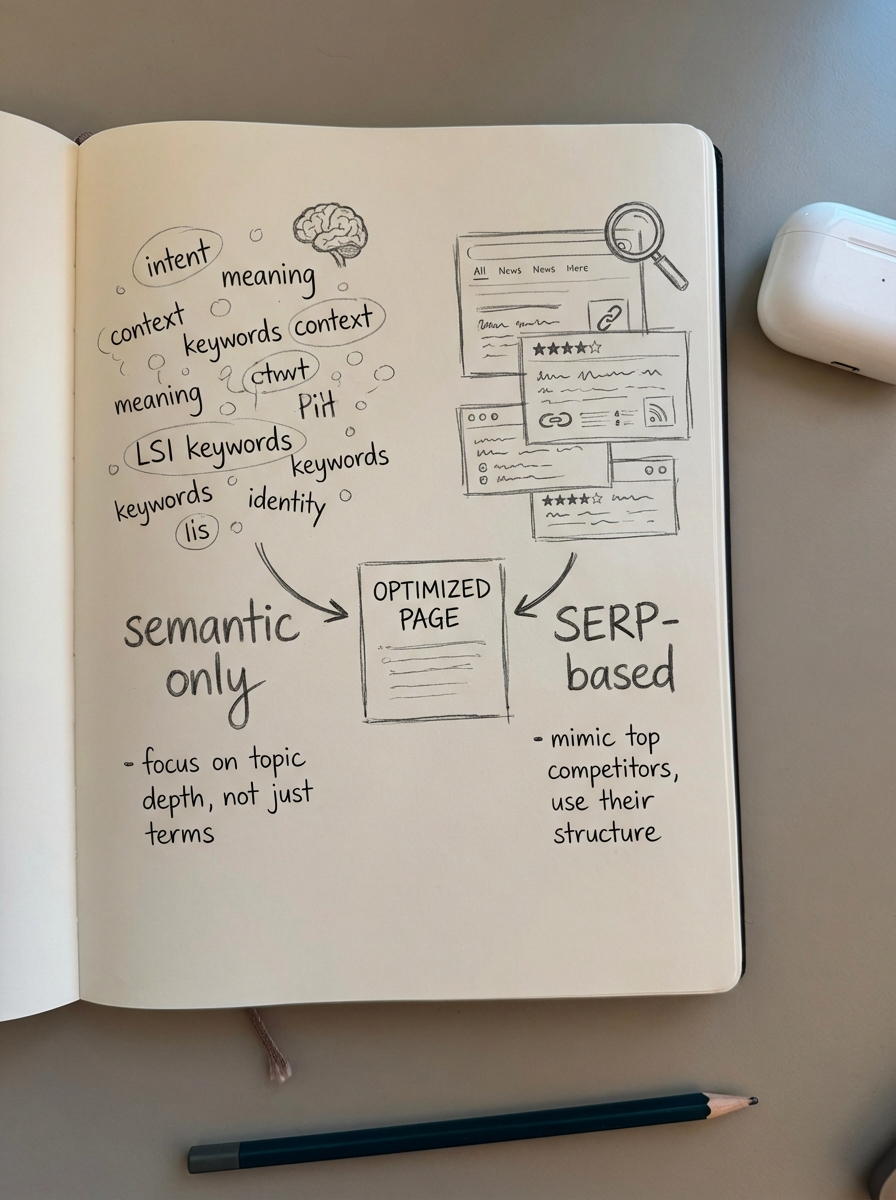
SERP-based clustering is the gold standard for ecommerce SEO. This method involves analyzing the actual Search Engine Results Pages (SERPs) for each keyword. If two keywords share a 70% or higher overlap in the URLs that rank on page one, Google is explicitly telling you they belong on the same page. This approach removes the guesswork from your strategy. If the SERP for “best protein powder” and “protein powder reviews” is identical, you only need one piece of content. We provide a free SERP keyword clustering tool to help you identify these overlaps without the manual heavy lifting usually required for large-scale analysis.
How to build an ecommerce keyword clustering workflow
Building clusters manually for a store with 10,000 products is a losing game. You need a repeatable, automated keyword research workflow that can handle high volume without sacrificing precision. I approach this by focusing on data integrity first, followed by strict intent separation to ensure the content serves the right stage of the funnel.
Gather your data (and recognize its limits)
Start by exporting data from Google Search Console and your primary SEO tools. However, you must be wary of your sources. I have found that third-party keyword data is frequently limited because their databases are often too small to accurately represent long-tail opportunities in specific niches.
Do not be afraid to target zero search volume keywords if you know your customers are actually asking those questions in support tickets or internal site searches. These niche queries often have the highest conversion rates because they reflect a very specific, mature buyer intent.
Run the clustering algorithm
Once you have your list, use a tool to automatically group keywords into clusters based on SERP similarity. This will typically output a “Parent Keyword” – the term with the highest volume or broadest intent – and several “Child Keywords” that represent supporting terms.
During this phase, ignore the scores from content optimization tools like Yoast or RankMath. These tools operate purely on gamification and have little impact on actual ranking results compared to the structural power of a well-organized cluster.
Separate intent: Transactional vs. Informational
This is the most critical step for any ecommerce professional. You must separate your clusters based on the user’s goal:
- Transactional clusters, such as “buy ergonomic office chair,” should always be mapped to your product or category pages.
- Informational clusters, like “how to choose an ergonomic chair,” should be mapped to blog posts, guides, or educational resources.
A common failure in ecommerce SEO is trying to rank a product page for an informational query. If the SERP is already full of “How-to” guides, your product page will never rank there, regardless of how much you optimize the metadata.
Prioritize category pages over product pages
In ecommerce SEO, it is way more important to optimize category pages than product pages. Individual products go out of stock, get updated, or are discontinued, but a category is evergreen. Use your clusters to make category names more specific and buyer-friendly. Instead of a generic “Shoes” category, clusters might reveal that you need a “Waterproof Trail Running Shoes” category to capture specific, high-intent traffic that a broader page would miss.
Using clusters to build topical authority
Once your clusters are defined, you can use them to build a “hub and spoke” model. The “Hub” is your main category page, and the “Spokes” are the informational blog posts that answer specific questions within that cluster. This creates a logical hierarchy that makes it easy for both users and crawlers to navigate your site.
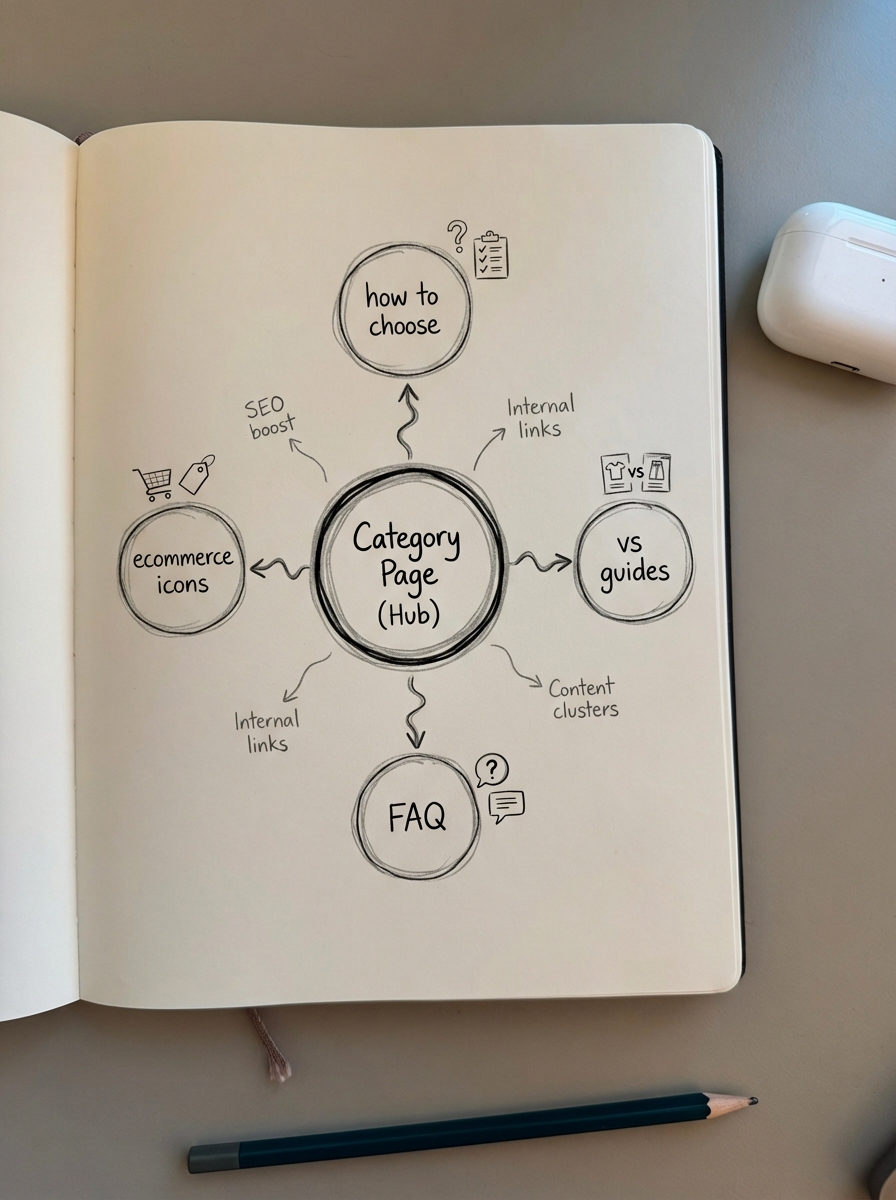
If you sell mattresses, for instance, your pillar category might be “Memory Foam Mattresses.” Your cluster content would then consist of blog posts like “How long do memory foam mattresses last?” or “Memory foam vs. Spring mattresses.” This structure creates a web of internal linking that signals deep topical authority to Google.
At ContentGecko, we focus on automating this entire process. Our platform syncs your product catalog with an AI-driven blog that understands which products are in stock and which categories require the most internal link support. This ensures your cluster strategy stays updated even as your inventory changes daily.
TL;DR
Keyword clustering is the process of grouping search terms by intent and SERP similarity to target multiple keywords with one page. For WooCommerce stores, this prevents content cannibalization, helps prioritize category page optimization over product pages, and provides a roadmap for building topical authority through advanced keyword research. Use SERP-based clustering to ensure your content strategy aligns with how Google actually categorizes and rewards information.