
January 20, 2026
SEO ROI calculation for WooCommerce stores

SEO ROI for WooCommerce is measured in gross profit and customer lifetime value, not organic traffic or keyword rankings. If you cannot tie a specific content campaign back to a checkout event, you are essentially flying blind. I have seen many stores celebrate a 50% increase in traffic while their bottom line remains stagnant because that traffic was top-of-funnel fluff that didn’t align with their product catalog.
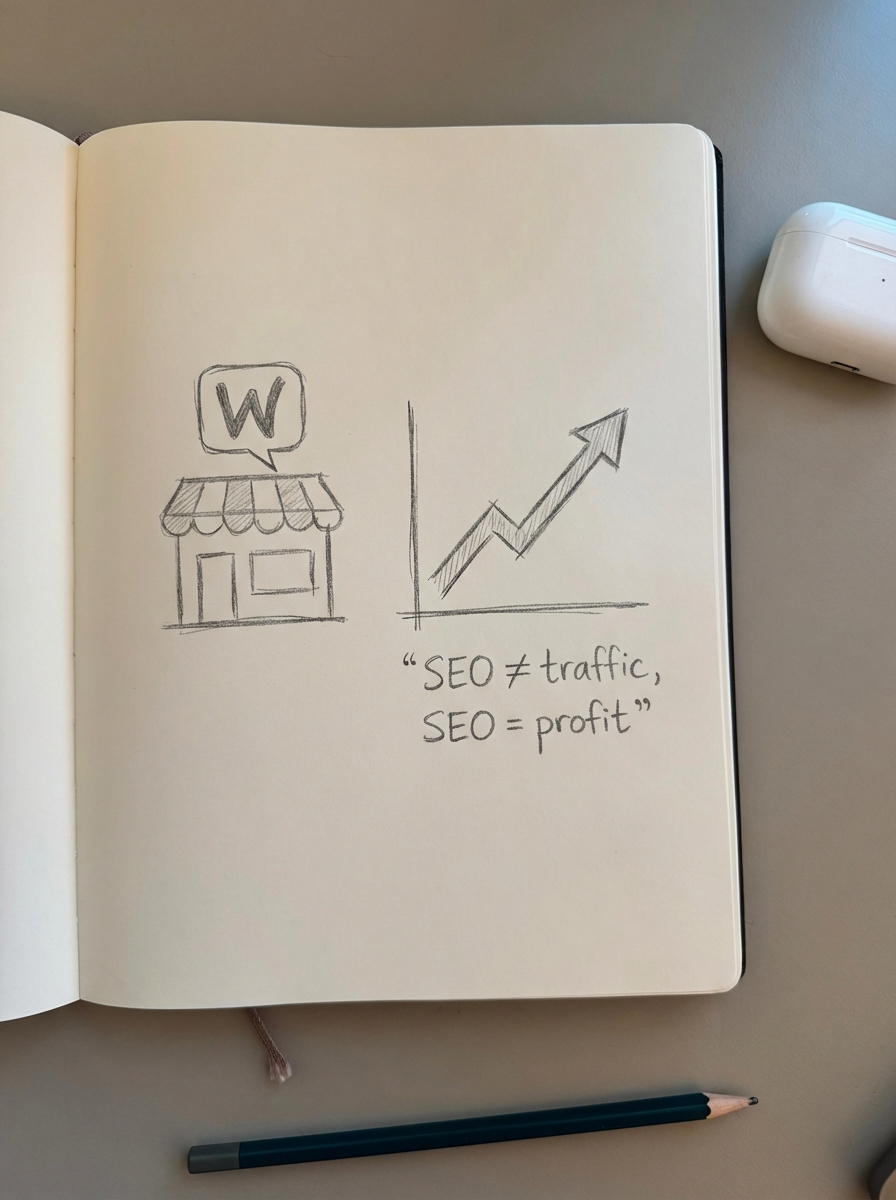
Proving ROI requires moving past vanity metrics and using first-party ecommerce data to justify every dollar spent on content and technical optimization. You must treat your SEO strategy as a compounding financial asset rather than a monthly maintenance cost.
How to define SEO ROI for ecommerce
In the context of a WooCommerce store, SEO ROI is the measurement of the profit generated from organic search activities relative to the total cost of those activities. Unlike PPC, where the relationship between spend and clicks is linear and immediate, SEO scales exponentially over time as your authority grows.
Most marketing leaders make the mistake of relying on “estimated traffic value” from third-party tools. I find that third-party keyword databases are often too small and their search volume data is frequently off by a significant margin. Instead, you should focus on your own analytics to understand the specific unit economics of your organic channel.
True ROI must account for several critical factors:
- Customer Acquisition Cost (CAC): Comparing how much you spent on SEO to acquire a customer versus your PPC spend.
- Customer Lifetime Value (CLV): It is a documented trend that organic customers typically have a 20-30% higher LTV than those acquired through paid social or search.
- Gross Margin: Calculating ROI on top-line revenue is dangerous if your margins vary significantly across different product categories.
The fundamental SEO ROI formula
The basic calculation for determining your return is straightforward, but the inputs require precision to be meaningful to stakeholders. The standard formula is:
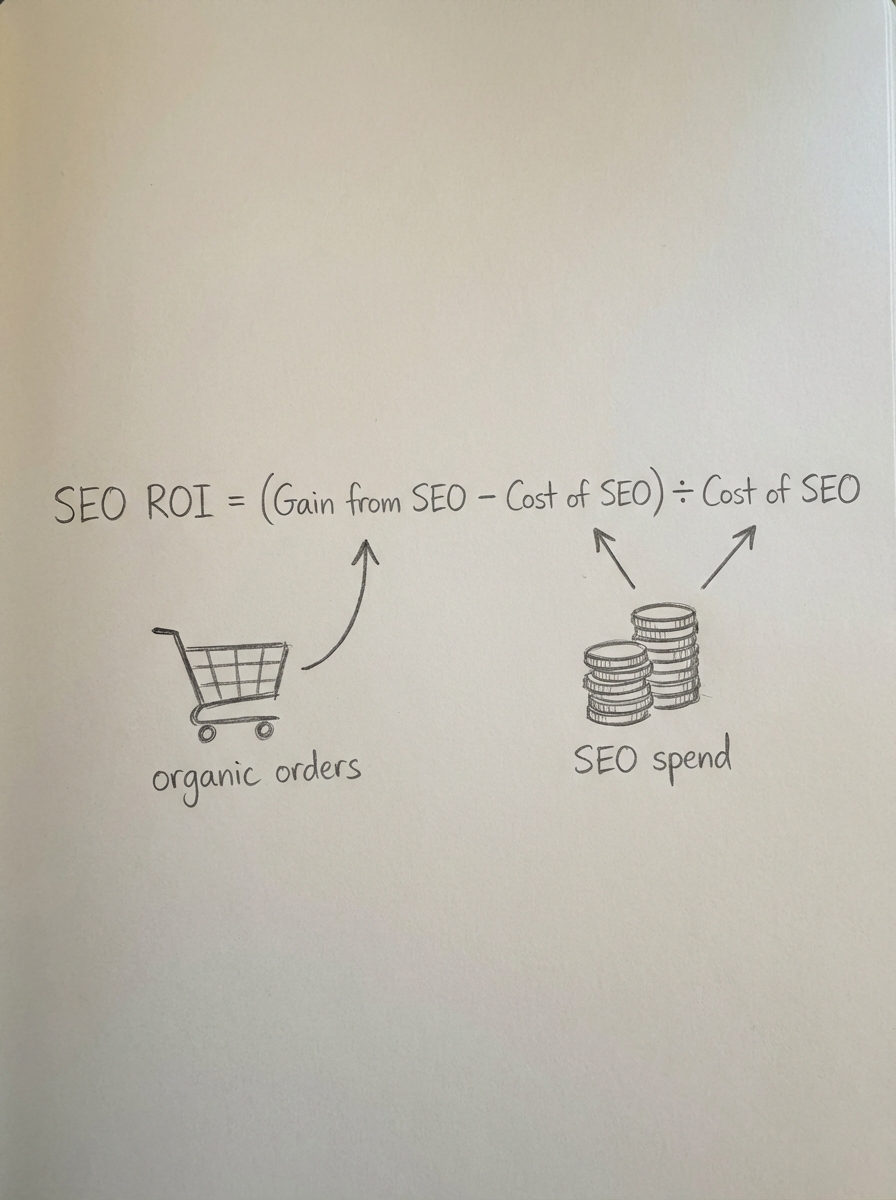
SEO ROI = (Gain from SEO - Cost of SEO) / Cost of SEO
To get an accurate “Gain from SEO,” you shouldn’t just look at total organic revenue. You need to segment your data to understand the nuances of the buyer journey. I recommend using a multi-touch attribution model to understand how many users discovered you via a blog post, left, and then returned via a branded search to purchase.
Defining the gain
- Direct Organic Revenue: Sales where the last click was organic search, providing the most immediate proof of value.
- Assisted Conversions: Revenue where organic search was a touchpoint earlier in the funnel but not the final click before the transaction.
- Long-Term Customer Value: Factoring in the projected value of the organic user over their entire relationship with your brand.
Defining the cost
- Personnel: The cost of internal salaries, freelance specialists, or agency fees dedicated to SEO.
- Tools: Ongoing costs for SEO reporting tools and analytics platforms used to monitor performance.
- Content Production: The specific cost of planning, writing, and updating articles and product descriptions.
Practical example for a mid-sized store
Consider a WooCommerce store selling high-end camping gear. They spend $5,000 a month on a structured content program designed to capture intent-driven search traffic. In this scenario, their monthly SEO cost is $5,000 and their total organic revenue is $45,000.
If we assume an average gross margin of 40%, the actual gain (profit) from SEO is $18,000. Applying the formula: ($18,000 - $5,000) / $5,000 results in an ROI of 2.6, or 260%. For every dollar spent, the store earns $2.60 in profit.
This matches industry benchmarks where WooCommerce stores often see an average SEO ROI of 2.6x after 12 months, which can scale to 5.2x after three years as content continues to compound and rank for more competitive terms.
Proving SEO value to stakeholders
The biggest hurdle in proving ROI is the time lag between action and result. Stakeholders often compare SEO to PPC, where you can turn a dial and see results tomorrow. To overcome this, I use a tiered reporting cadence that highlights different stages of growth.
In the short term (0-3 months), I focus on leading indicators such as keyword rankings for “MVP” content and technical health improvements. In the medium term (6-12 months), the focus shifts to growth in non-branded organic traffic and assisted conversions. This is often the “payback period” where SEO profit begins to exceed monthly spend. In the long term (12+ months), I report on the total “Gain from SEO,” including the higher LTV of customers acquired in previous quarters.
One effective strategy is to use “CPC Equivalency.” If you had to buy the same amount of organic traffic via Google Ads, what would it cost? Often, the “rental” price of that traffic is 5-10x higher than the cost of “owning” it through SEO, making the investment case much easier for a CFO to digest.
Measuring ROI by page type
Not all organic traffic is created equal, and grouping all organic data together is a common mistake. To get a granular view of ROI, you should break down performance by page type. I believe optimizing category names and category-level content is far more important for revenue than tweaking individual product pages, which often have higher turnover.
- Category Pages: These are your primary revenue drivers and should be monitored for their ability to capture broad-intent keywords.
- Product Pages: These represent bottom-of-funnel intent but can suffer from high churn if products go out of stock or URLs change.
- Blog/Informational Content: This drives top-of-funnel awareness. If your blog gets traffic but doesn’t convert, you likely have an internal linking or search intent mismatch.
We built the ContentGecko Ecommerce SEO Dashboard specifically to solve this visibility problem. It automatically segments your Google Search Console data by URL pattern, allowing you to see exactly which segment of your site is actually contributing to the bottom line without manual spreadsheet work.
Using automation to lower the cost side of the equation
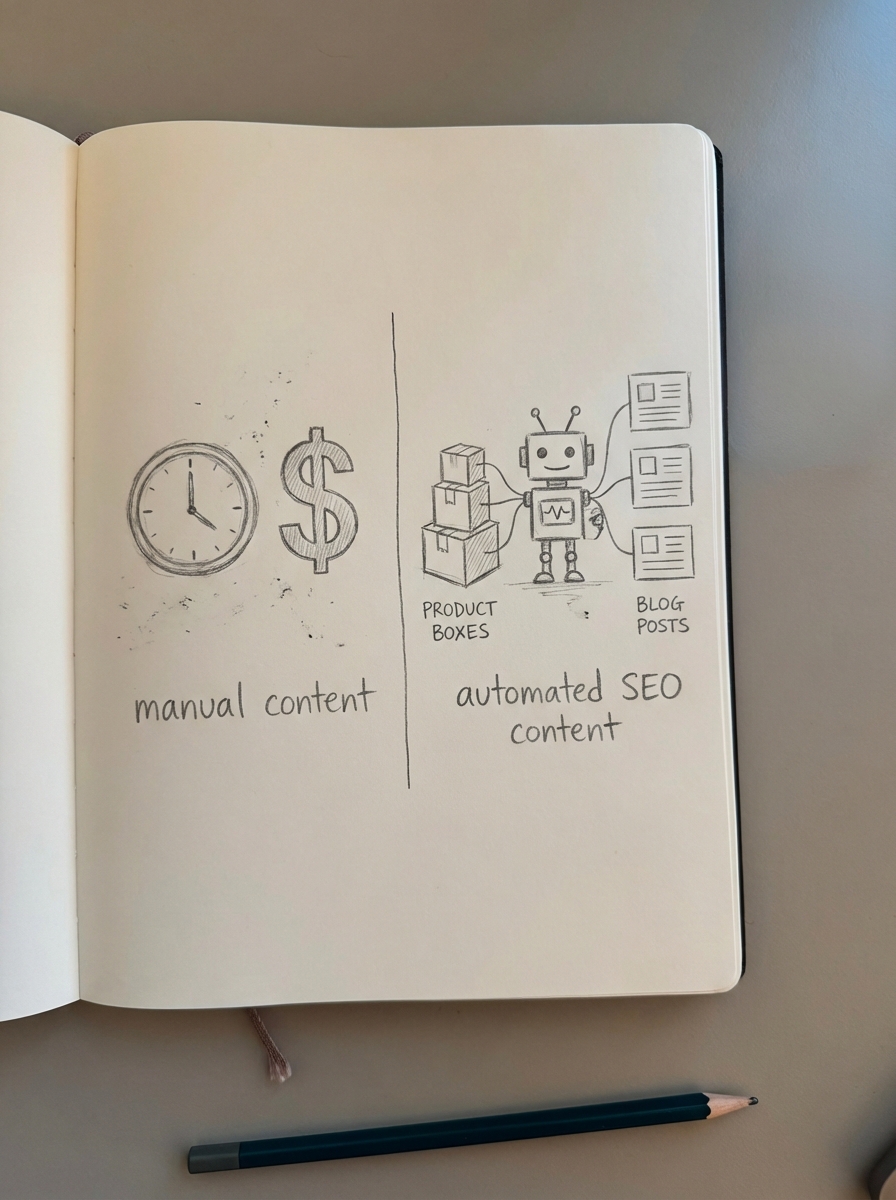
If your ROI is low, you have two levers: increase the gain or decrease the cost. Manual content production is typically the biggest cost variable in an SEO budget. Scaling a WooCommerce blog traditionally requires expensive freelancers and constant manual catalog syncing. If a product price or SKU changes, the content becomes outdated immediately, which hurts your conversion rates and wastes your investment.
At ContentGecko, we automate the planning and execution of conversion-focused SEO content to solve this inefficiency. By syncing directly with your product catalog, we ensure that the content remains accurate and includes smart links to your highest-margin products. This approach often results in a 50-70% reduction in content creation time, which significantly accelerates your path to a positive ROI by lowering the “Cost” side of the formula.
TL;DR
To calculate SEO ROI, subtract your total SEO costs from the gross profit generated by organic search, then divide by the total cost. For WooCommerce stores, you should prioritize non-branded traffic and segment performance by page type, as organic customers typically have a 20-30% higher LTV than paid leads. Use tools like the ContentGecko SEO ROI calculator to project long-term value and move your internal conversations from “traffic” to “profit.”