
January 20, 2026
Advanced keyword research for ecommerce growth

To win at ecommerce SEO today, you must abandon the search volume metrics found in third-party tools and instead align your keyword strategy directly with your WooCommerce product catalog and entity relationships. Standard keyword research workflows are failing merchants because they rely on databases that are fundamentally disconnected from the actual way consumers search for specific SKUs.
The failure of traditional keyword data
Most SEO tools operate on third-party databases that are too small to represent the true search landscape of a specific niche. If you only target keywords that show 1,000+ monthly searches, you are competing in a saturated market while ignoring the 39.33% of search opportunity found in the long tail. Only 0.16% of keywords actually receive more than 1,000 searches per month, meaning the vast majority of revenue-driving queries are hidden from standard filters.

In my experience, the most profitable keywords for an ecommerce store often show “Zero Volume” in tools like Ahrefs or Semrush. However, these long-tail keywords achieve 25% conversion rates compared to the 12% average for broad terms. I’ve seen stores build entire six-figure categories around terms that traditional tools claimed had no traffic. We believe that 3rd party keyword data is mostly useless for strategy because search volume and competition scores are often off by an order of magnitude. Instead of relying on these gamified metrics, you should focus on your own data and the actual structure of your product catalog.
Catalog-aware discovery: mining your own data
The best keyword opportunities are not found in an external tool; they are stored in your WooCommerce database and Google Search Console. Your customers often search for specific product attributes that you haven’t turned into SEO-friendly pages. If your store sells yoga mats, your attributes might include material types like cork, thicknesses like 6mm, or features like non-slip and extra wide.
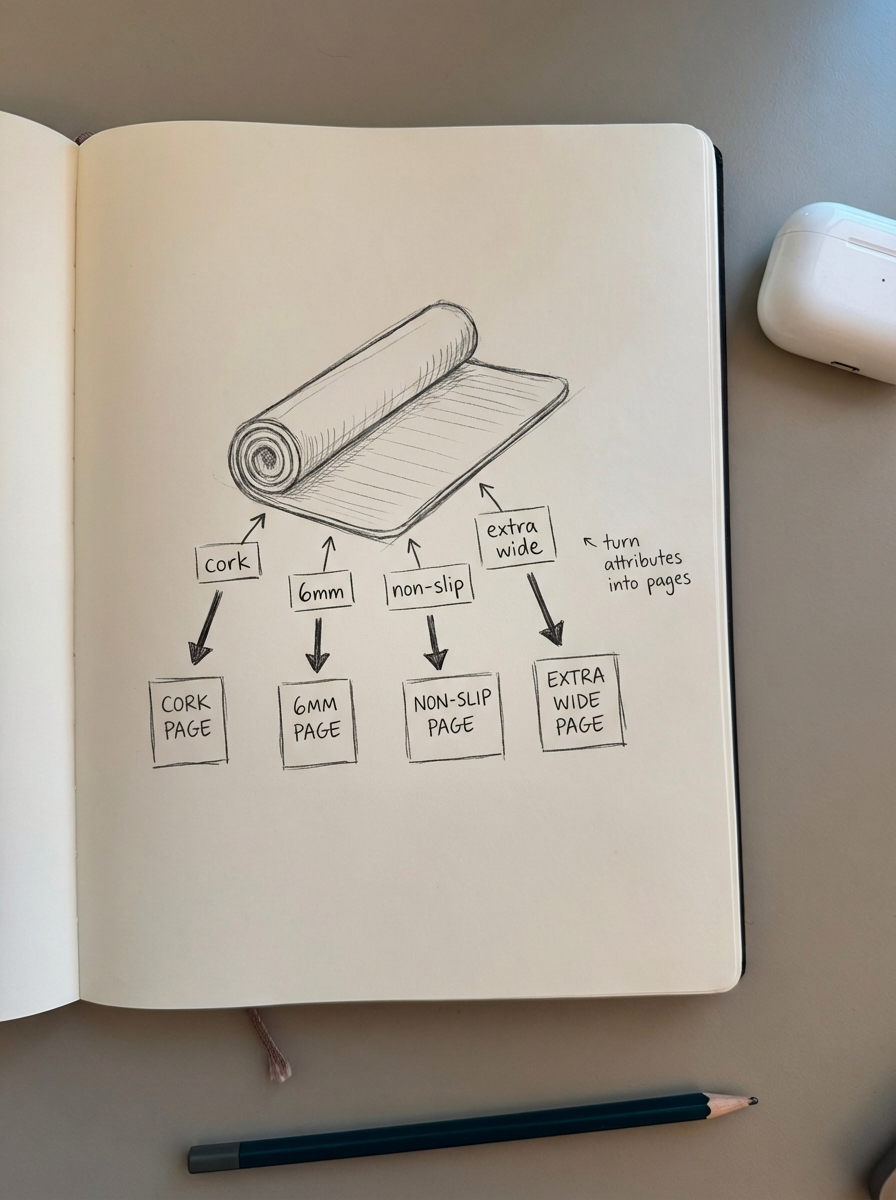
I recommend exporting your product attributes and cross-referencing them with internal search logs to see what users are looking for but can’t find. You should use these attributes to create specific sub-categories rather than relying on broad, vague category names. Most ecommerce sites would benefit greatly from more specific naming conventions to help buyers find products more easily. Our free ecommerce category optimizer can help identify exactly where your current structure is too generic.
Google Search Console provides first-party data that no third-party tool can replicate. I look for keywords with high impressions but low click-through rates (CTR) that are currently ranking on pages two or three. You can filter your GSC reports to show queries with a position between 10 and 20. These are unoptimized keywords you already rank for, and they often signal the need for a new content cluster or a dedicated category page to satisfy that specific intent.
Advanced clustering beyond semantic similarity
Grouping keywords by meaning is a logical starting point, but semantic clustering is often disconnected from how search engines actually treat intent. For ecommerce, you need SERP-based clustering to ensure your content maps to Google’s behavior. If two keywords share a significant overlap in the top 10 results, they belong on the same page; if they do not, you require separate URLs.
- Analyze keywords for a 70% or greater overlap in search results.
- Distinguish between terms like “best running shoes” and “running shoe reviews” if the SERPs show different content types.
- Create a content mapping strategy that addresses these intent gaps.
You can use our free SERP keyword clustering tool to automate this process. It identifies which keywords can be targeted with a single category or blog post and which require unique URLs to avoid automatically-group-keywords issues like content cannibalization.
Entity-based research and LLM optimization
Modern search is moving from simple strings to complex things. Google’s Knowledge Graph and AI-powered search engines like Perplexity look for entity relationships to determine topical authority. When I research a new category, I’m not just looking for keywords; I’m looking for related concepts that define the niche. If you sell mechanical keyboards, related entities include switches, keycaps, latency, PCB, and actuation force.
To satisfy both traditional search engines and modern AI, you should build content clusters that cover these entities comprehensively. Content that covers the full entity map typically ranks higher for long-tail queries because it demonstrates depth. I suggest using nested H2, H3, and H4 structures to define these relationships on the page. Do not waste time writing meta descriptions; by 2026, Google will rewrite them anyway based on the entities it detects in your content.
Structuring the ecommerce blog
If the basics of your ecommerce SEO are done well – meaning a clean site structure and fast loading times – the remaining opportunity is almost entirely in your blog. However, most brands produce thought-leadership content that never ranks for valuable keywords. For WooCommerce, your blog should function as a high-conversion funnel for your catalog.
- How-to guides: Solving a problem where your product is the direct solution.
- Buyer guides: Helping users navigate the specific attributes you identified in your research.
- Comparisons: Targeting competitor keyword gaps by comparing your product entities to theirs.
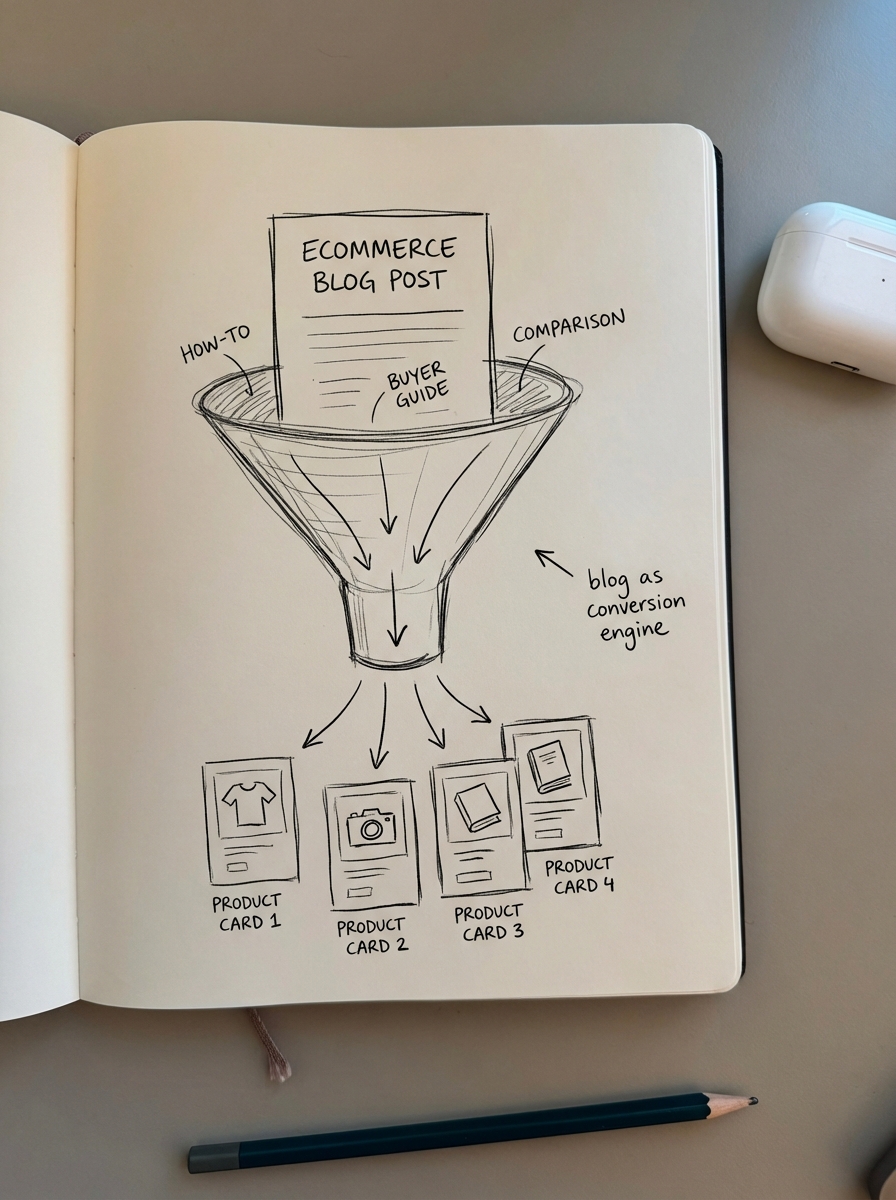
At ContentGecko, we facilitate this by syncing your product catalog directly to your blog. We do not just find keywords; we identify catalog-aligned opportunities and use our AI SEO content writer to produce articles that auto-update when your SKUs, prices, or stock status change. This ensures your content remains accurate and conversion-focused without manual intervention.
TL;DR
Stop relying on inaccurate third-party search volume data and instead mine your WooCommerce catalog attributes and GSC data to find non-obvious long-tail terms. Use different keyword clustering methods to structure these into specific category pages rather than generic ones. Focus on building entity relationships to satisfy modern AI search engines and use an automated, catalog-synced blog to capture the remaining search intent at scale.