
January 20, 2026
Best free keyword research tools for WooCommerce stores

You do not need a four-figure monthly SEO suite to identify the search terms that drive revenue. For most WooCommerce merchants, the highest-ROI data is not hidden in a proprietary database; it is either sitting in your own search console or hiding in plain sight on the search engine results page (SERP).
First-party data is your only source of truth
I have consistently found that most third-party keyword data is directionally useful at best and flat-out wrong at worst. These tools often rely on small clickstream databases that fail to capture the hyper-specific, long-tail queries your customers actually use. If you want accuracy, you must prioritize Google’s own data over third-party estimates that frequently hallucinate search volume and competition metrics.

Google Search Console
Google Search Console (GSC) is the most underrated keyword tool available to ecommerce merchants. It provides first-party data on the exact queries already driving impressions and clicks to your store. I typically ignore the high-level “top queries” and instead look for the “low-hanging fruit.”
I recommend filtering your performance report for queries with high impressions but low click-through rates (CTR) that are currently ranking in positions 8 through 20. These terms are signals that Google already associates your site with the topic, but your current page is not quite satisfying the user intent or visibility requirements to win the click. By refining these existing pages through a structured Google Search Console keyword research workflow, you can often push these terms into the top five with minimal effort.
Google Keyword Planner
While many SEOs dismiss Keyword Planner as a tool only for advertisers, it remains essential for validating keyword difficulty in SEO. Because the data comes directly from Google’s advertising API, it offers the most reliable look at commercial intent. If a keyword shows “High” competition in Keyword Planner, it is a definitive signal of transactional value. I would rather target a keyword with 50 monthly searches and high advertiser competition than one with 5,000 searches and no commercial backing.
Identifying high-intent ecommerce clusters
In ecommerce SEO, search volume is often a vanity metric. What matters is the specificity of the intent. A query like “best waterproof hiking boots for wide feet” is worth significantly more to your bottom line than “hiking boots” because the user has already narrowed their requirements and is closer to a purchase decision.
AnswerThePublic and Google Autocomplete
To discover these long-tail keywords, AnswerThePublic is an excellent resource for uncovering the specific questions and “versus” queries that buyers ask during their research phase. However, I often find that Google Autocomplete is even more valuable for real-time trends. It suggests queries that third-party tools haven’t even indexed yet. When I am finding low competition keywords, I look for these autocomplete variations and “People Also Ask” boxes to build informational content that supports my product catalog.
ContentGecko free SERP clustering
Once you have a raw list of potential keywords, the most common mistake is creating a separate page for every variation. This leads to a bloated website with duplicate pages and internal cannibalization. I have seen countless stores waste their crawl budget by creating separate pages for “athletic shoes” and “running shoes” when Google actually treats them as the same intent.

Our free SERP keyword clustering tool solves this by analyzing the actual URLs that rank for each term. If two keywords share 70% or more of the same results in the top 10, they belong on the same page. Using keyword clustering tools to group your list ensures you are building a lean site architecture that builds topical authority without competing against yourself.
Optimizing for the ecommerce funnel
Many WooCommerce merchants spend an excessive amount of time tweaking product pages while neglecting their category pages. This is a strategic error. Category pages are your strongest SEO assets because they are naturally broader, satisfy “browsing” intent, and are far easier to rank than individual SKUs.
ContentGecko free category optimizer
Most stores use vague, non-descriptive category names like “Accessories” or “New Arrivals.” This provides zero context to search engines. Our free ecommerce category optimizer analyzes your store structure to suggest specific, buyer-friendly titles. For example, changing a generic “Grinders” category to “Burr Coffee Grinders for Espresso” can result in an immediate ranking boost because it matches the specific way customers search. This is often the fastest “quick win” available to an ecommerce site.
The transition from research to execution
Free tools are perfect for the discovery phase, but they hit a hard ceiling as your catalog grows. If you are managing more than 500 products, manual keyword research and content maintenance become unsustainable. The challenge is not just finding the right keywords; it is keeping your content in sync with a moving inventory. I have seen many stores lose trust because their highest-ranking blog posts link to products that have been out of stock for months.
A pragmatic, content-led strategy involves building a WooCommerce keyword research framework that prioritizes your categories and then automates the heavy lifting of content creation. For stores scaling toward thousands of SKUs, the focus must shift toward:
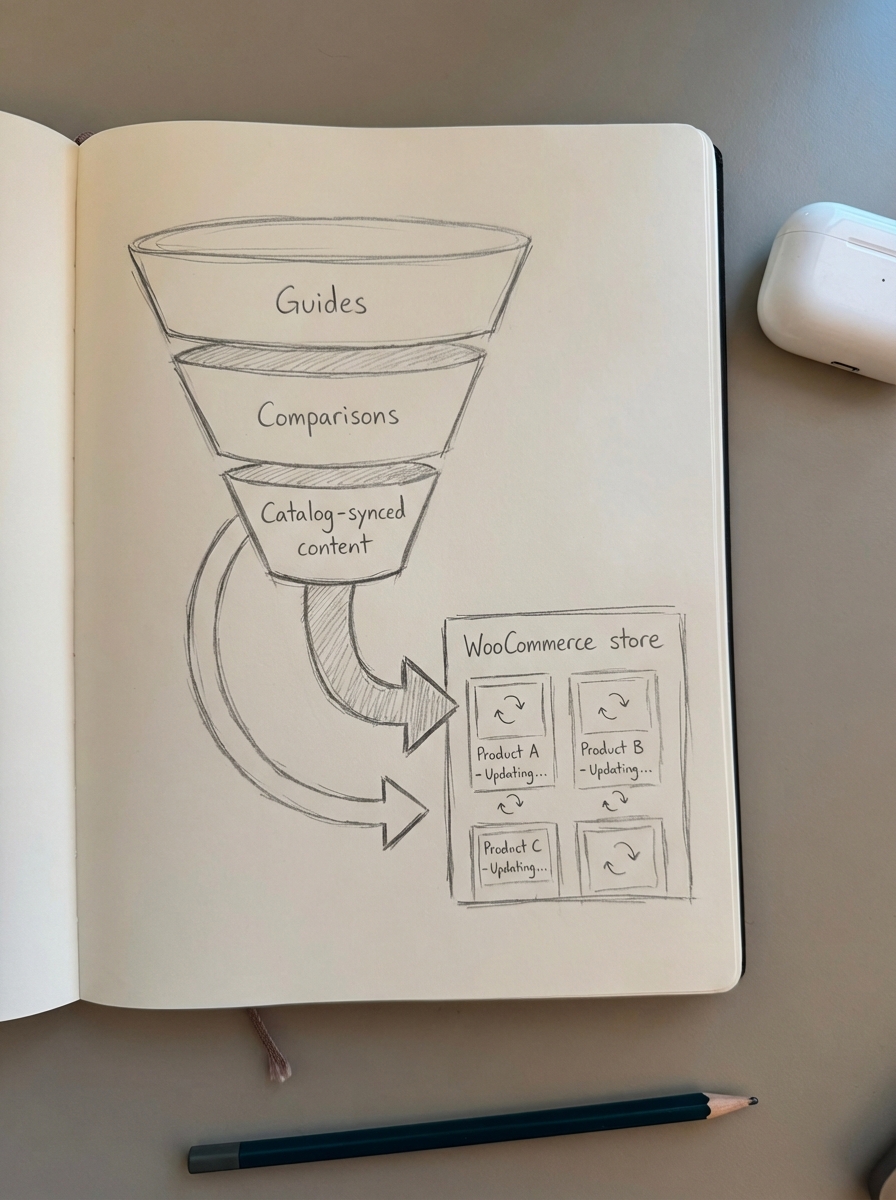
- Top-of-funnel buyer guides that address common customer pain points.
- Middle-of-funnel comparison articles that highlight your unique product attributes.
- Automatic updates that refresh content when prices, stock levels, or URLs change.
We built ContentGecko to handle this lifecycle for growing stores. Instead of manually writing and updating posts, our platform uses your product catalog data to plan, write, and publish catalog-synced content directly to your site. This ensures your SEO efforts are always tied to your actual inventory, turning search traffic into measurable SKU performance.
TL;DR
- Trust first-party data sources like Google Search Console and Keyword Planner over third-party databases that rely on small clickstream samples.
- Prioritize search intent over raw volume by targeting long-tail, question-based keywords that signal a readiness to buy.
- Use SERP-based clustering to group keywords based on what Google actually displays, which prevents content cannibalization and site bloat.
- Focus on optimizing category pages rather than individual product pages, as categories hold more topical authority and satisfy broader search intent.
- Adopt specific category names to improve relevance for middle-of-the-funnel searches using specialized optimization tools.
- Automate your content execution once your catalog exceeds 500 products to ensure your SEO articles stay synced with your current prices and stock levels.