
January 20, 2026
Keyword research for ecommerce blog posts that drive revenue

Most ecommerce blogs fail because they target high-volume “thought leadership” terms that have no clear path to a purchase. If you want your blog to drive revenue rather than just vanity metrics, your keyword research must start with your product catalog rather than a third-party SEO tool’s database.
Why third-party keyword data is often a distraction
I’ve found that relying solely on third-party keyword tools is one of the biggest mistakes WooCommerce marketers make. These databases are often too small to reflect real-world niche opportunities, and their search volume estimates can be off by orders of magnitude. For most ecommerce sites, 3rd party keyword data is nearly useless because it lacks the context of your specific inventory and buyer behavior.
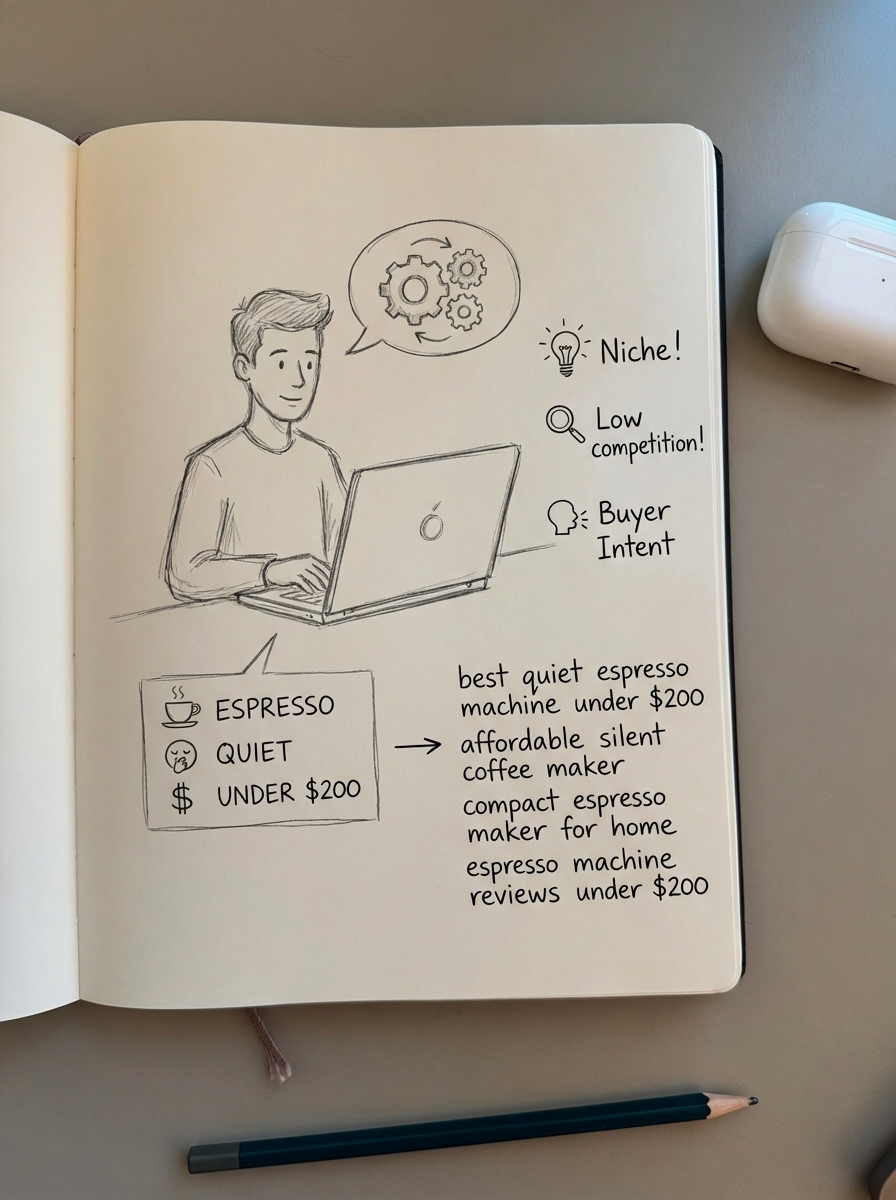
Instead of chasing generic volume, you should prioritize niche keyword research that aligns with your specific SKUs. Niche keywords often yield conversion rates as high as 25%, which is significantly higher than the 12% average for broad, high-volume terms. For example, the e-commerce brand Promoty achieved a 224% increase in traffic by targeting long-tail terms with specific intent rather than broad industry jargon.
At ContentGecko, we believe in iterating content like a product. We recommend launching an MVP – often an initial AI-generated article – and then using first-party data from Google Search Console keyword research to refine the post once it begins gaining impressions. This approach allows you to optimize for the exact phrases your audience uses, rather than what a tool guesses they might use.
A step-by-step workflow for catalog-aware keyword research
To build a blog that actually sells, you need a workflow that extracts “seed” ideas from your products and expands them into informational clusters. This process ensures that every article you publish has a direct internal link back to a buyable product.
Extract seeds from your WooCommerce attributes
Do not start your research with a blank search bar in an SEO tool. Instead, export your WooCommerce product list and analyze your attributes such as material, use case, and compatibility. If you sell a burr coffee grinder with attributes like “espresso,” “quiet,” and “under $200,” those become your seed ideas. You aren’t just looking for “coffee grinder”; you are looking for “quiet coffee grinders for espresso.” These specific modifiers are where the highest conversion potential lies.
Identify the problem-solution bridge
For every product category, identify the specific problem a customer is trying to solve before they realize they need your product. This is where long-tail keywords live. If a user is searching for “why is my espresso bitter,” they have a problem. Your blog post explaining how grind size affects bitterness becomes the bridge to your solution: a high-quality burr grinder. By answering the question first, you establish the authority needed to make the sale.
Use SERP-based clustering to avoid cannibalization
One of the most common technical SEO mistakes is a bloated website with duplicate pages targeting the same intent. To prevent this, you must understand what is keyword clustering and how to apply it. We advocate for semantic vs serp clustering methods that focus on actual search results.
If two different keywords return a 70% overlap of the same URLs in the top 10 results, Google considers them to have the same search intent. In this case, you should target them with a single, comprehensive post rather than two separate articles that will only compete with each other. You can use our free SERP keyword clustering tool to automate this grouping and ensure your site structure remains lean and efficient.
Perform a competitor keyword gap analysis
Identify your true search competitors, which often include publishers and review sites like Wirecutter rather than just other retail stores. Use competitor keyword gap analysis to find informational terms they rank for that your site is currently missing. If a competitor is ranking for “best hiking boots for wide feet” and you have wide-width boots in stock, that represents a high-priority content gap that can drive immediate revenue.
Mapping keywords to the buyer journey
Not all blog traffic is created equal. You must categorize your keywords by intent to ensure you are not just attracting “lookers” who never convert. High-intent traffic is more valuable than high-volume traffic every time.
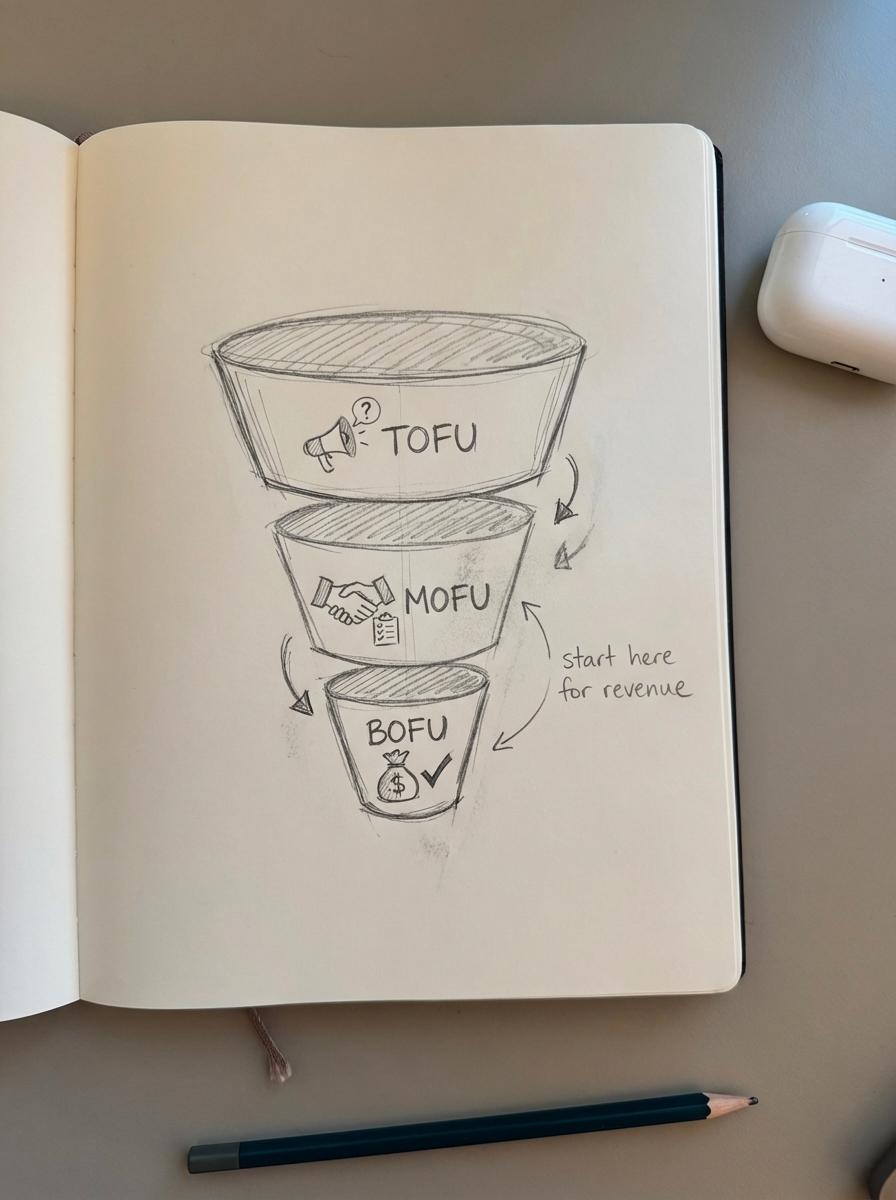
- Top of Funnel (TOFU) queries involve broad educational topics, such as “how to start a vegetable garden.” These have high volume but low conversion rates.
- Middle of Funnel (MOFU) queries focus on comparisons and “best of” lists, like “organic vs synthetic fertilizer.”
- Bottom of Funnel (BOFU) queries are highly specific and product-adjacent, such as “best fertilizer for heirloom tomatoes in spring.”
I recommend focusing on BOFU and MOFU clusters first. While finding low competition keywords in the TOFU stage can help build topical authority, it rarely moves the needle on revenue in the short term. Prioritize the terms that sit closest to the “Add to Cart” button.
Scaling your research with automation
For stores with more than 1,000 products, manual keyword research becomes a massive bottleneck. Maintaining a blog manually is unsustainable when SKU data, prices, and stock levels change daily. This is why we built ContentGecko.
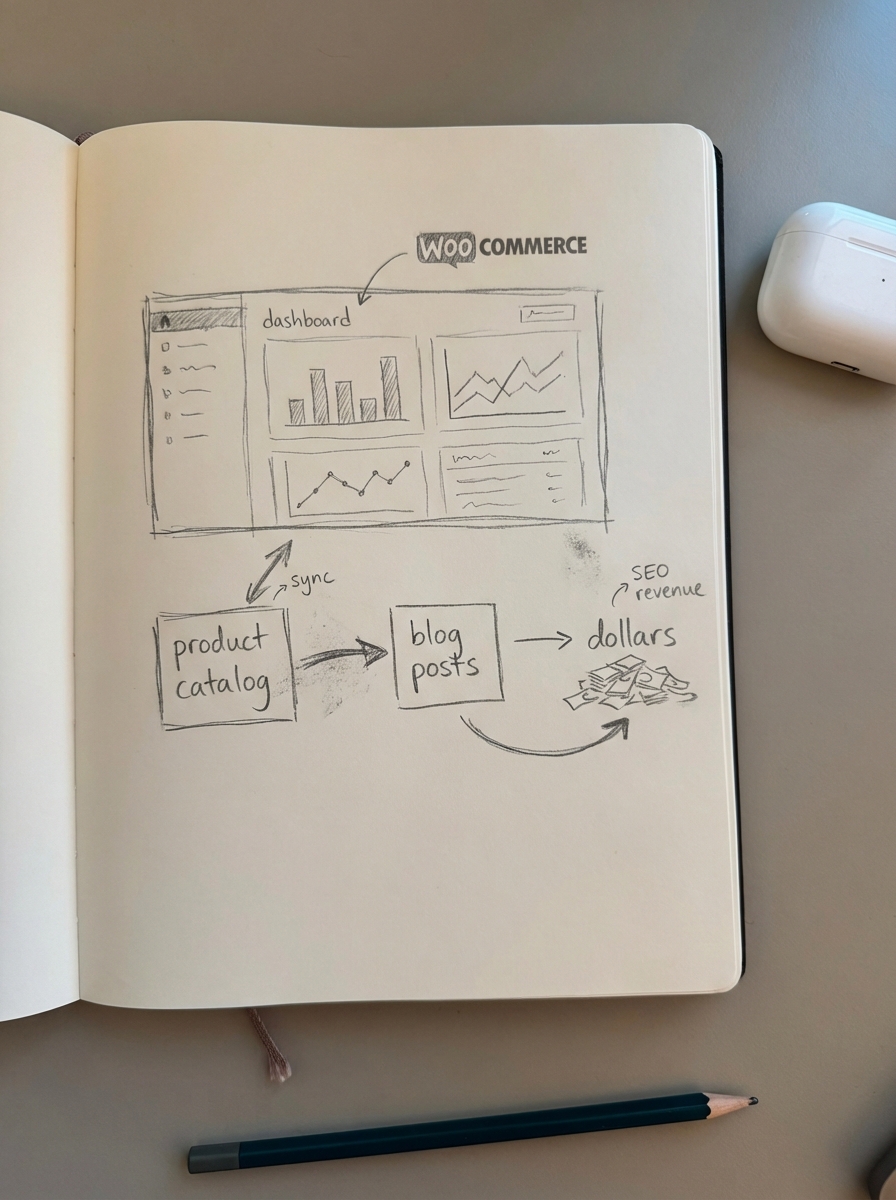
Our platform syncs directly with your WooCommerce catalog via our WordPress connector plugin. It identifies keyword opportunities based on your actual inventory levels and category hierarchy. When a product goes out of stock or you add a new category, the content plan and existing blog posts update automatically. This ensures that your organic traffic is always directed to buyable products, preventing the “dead-end” user experience common in many ecommerce blogs. You can monitor the revenue impact of these efforts through a dedicated ecommerce SEO dashboard that separates blog performance from category and product page metrics.
TL;DR
Effective keyword research for ecommerce blogs requires shifting from volume-chasing to intent-mapping. Start by extracting seeds from your product attributes and use keyword clustering to group terms by SERP similarity, which prevents content cannibalization. Prioritize long-tail phrases that bridge the gap between a user’s problem and your product’s solution. For large stores, utilize automation to keep your content synced with your live catalog and monitor your growth through a specialized dashboard.